
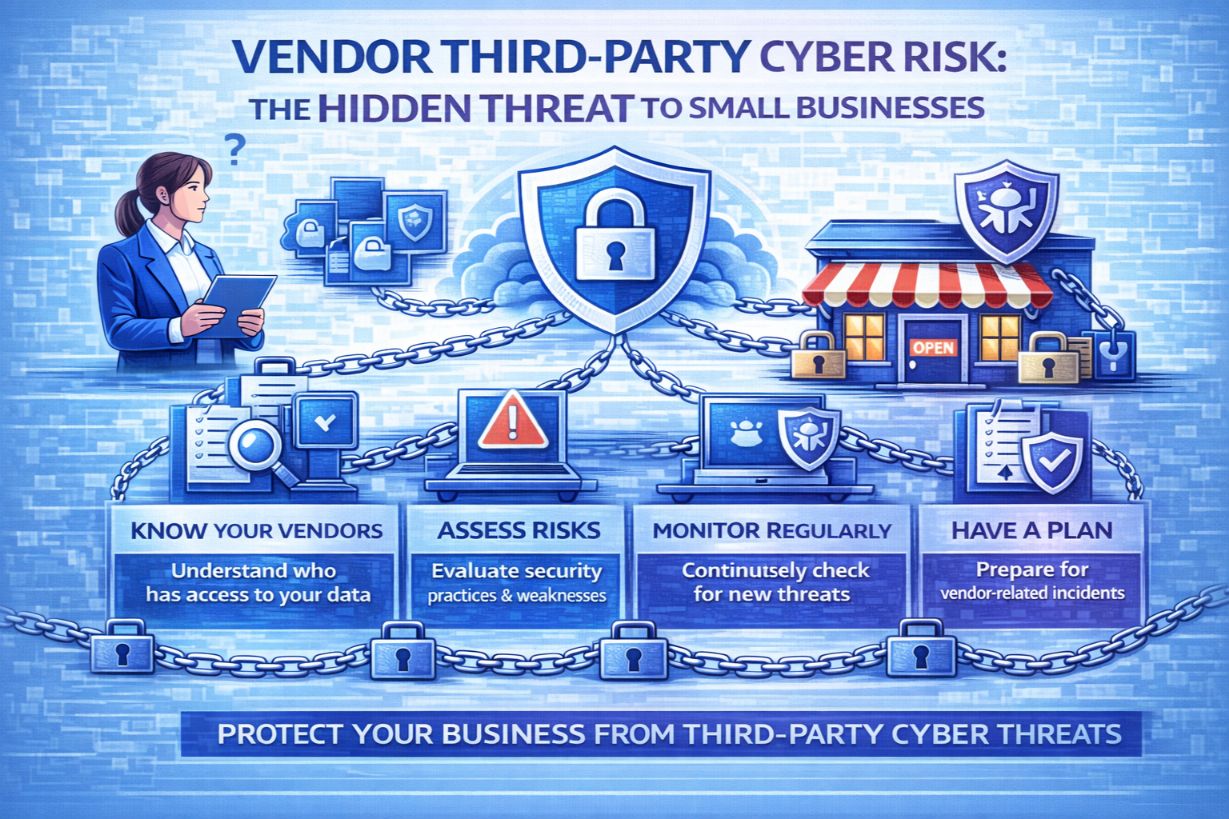
Vendor & Third-Party Cyber Risk: The Hidden Threat to Small Businesses
Many small businesses invest heavily in securing their own systems—while unknowingly leaving the door wide open through vendors.
Accounting firms, IT providers, SaaS platforms, contractors, marketing agencies, payroll processors—every third party you trust inherits some level of access to your business.
Attackers know this.
Third-party access is now one of the fastest and quietest paths into SMB environments, not because vendors are malicious, but because vendor risk is rarely managed intentionally.
This article explains third-party cyber risk for small businesses, why it’s so dangerous, where SMBs go wrong, and how to manage vendor risk realistically—without enterprise bureaucracy.
Why Vendor Risk Is So Dangerous for SMBs
Vendor risk is dangerous because:
- Access is external
- Oversight is limited
- Trust is assumed
- Accountability is blurred
When something goes wrong, SMBs often discover:
- They didn’t know what access vendors had
- They didn’t control how vendors authenticated
- They didn’t monitor vendor activity
That’s not a vendor failure—it’s a governance failure.
What Counts as a Third Party?
For SMBs, third parties include:
- Managed IT and security providers
- Cloud and SaaS vendors
- Payroll and HR platforms
- Accounting and tax firms
- Marketing agencies
- Contractors and consultants
If they can access your systems or data, they are part of your attack surface.
The Most Common Third-Party Breach Scenarios
Scenario 1: Vendor Credential Compromise
Attackers steal:
- Vendor credentials
- Shared admin accounts
- Weakly protected logins
Result:
- Legitimate access abused
- Breach bypasses perimeter defenses
Scenario 2: Over-Permissioned Vendor Access
Vendors are given:
- Broad access “temporarily”
- Admin rights “just in case”
That access persists long after it’s needed.
Scenario 3: Vendor Software Compromise
A trusted vendor:
- Is breached
- Pushes malicious updates
- Exposes shared data
SMBs inherit the damage without control.
Scenario 4: Shadow Vendors
Departments sign up for:
- Tools
- Services
- Integrations
Without security review.
Unknown vendors = unmanaged risk.
Why SMBs Underestimate Vendor Risk
SMBs assume:
- “They’re professionals—they must be secure”
- “We trust them”
- “We can’t control them anyway”
Trust is not a control.
Contracts are not enforcement.
Hope is not strategy.
The Shared Responsibility Illusion
Many SMBs assume:
“Security is the vendor’s responsibility.”
Reality:
- Vendors secure their environment
- You secure how they access yours
Responsibility is shared—but liability often isn’t.
What SMBs Are Actually Accountable For
Regardless of vendor behavior, SMBs are accountable for:
- Granting access
- Limiting permissions
- Monitoring activity
- Protecting customer data
Regulators and insurers care about your controls, not vendor excuses.
The Core Principles of Third-Party Risk Management (SMB Edition)
You don’t need a GRC platform.
You need discipline.
Principle 1: Know Your Vendors
If you don’t know:
- Who your vendors are
- What systems they access
You cannot manage risk.
Start with an inventory.
Principle 2: Limit Vendor Access Ruthlessly
Vendor access should be:
- Role-based
- Time-bound
- Least privilege
No standing admin access unless absolutely required.
Principle 3: Enforce Strong Authentication
Vendors should:
- Use unique accounts
- Use MFA
- Never share credentials
Shared vendor accounts are breach accelerators.
Principle 4: Monitor Vendor Activity
You should be able to answer:
- When did vendors log in?
- What did they access?
- What changed?
Monitoring turns blind trust into managed trust.
Principle 5: Remove Access When Work Ends
Offboarding vendors is just as important as onboarding.
Access should be:
- Reviewed regularly
- Removed promptly
- Documented
Stale access is silent risk.
Vendor Due Diligence: How Much Is Enough?
SMBs do not need:
- 200-question questionnaires
- SOC 2 deep dives for every vendor
They do need:
- Basic security expectations
- Proof of MFA usage
- Clear breach notification terms
Proportional diligence is defensible diligence.
Contractual Controls That Actually Matter
Focus contracts on:
- Data protection obligations
- Breach notification timelines
- Access control requirements
- Right to terminate access
Contracts don’t stop breaches—but they shape outcomes.
Vendor Risk and Cyber Insurance
Insurers increasingly ask:
- How vendors access systems
- Whether MFA is enforced
- How access is monitored
Vendor mismanagement can:
- Increase premiums
- Reduce coverage
- Complicate claims
Vendor risk affects insurability.
Common SMB Vendor Risk Mistakes
- Giving vendors admin rights
- Using shared accounts
- Never reviewing access
- Ignoring SaaS integrations
- No breach notification plan
These mistakes accumulate quietly.
How SMBs Should Prioritize Vendor Risk
Not all vendors are equal.
Prioritize vendors that:
- Access sensitive data
- Have persistent access
- Can change systems
- Support critical operations
Low-impact vendors require less scrutiny.
A Simple Vendor Risk Tiering Model
- Tier 1: Full access to systems/data
- Tier 2: Limited access or integrations
- Tier 3: No system access
Apply controls accordingly.
Vendor Risk During Incidents
During incidents:
- Vendor access must be reviewed immediately
- Compromised vendors must be isolated
- Logs must be preserved
Incident response plans should include vendor coordination.
Why Vendor Risk Is a Leadership Issue
Vendor access decisions involve:
- Cost vs risk tradeoffs
- Operational dependency
- Contractual obligations
Leadership must:
- Approve risk tolerance
- Enforce standards
- Support access restrictions
This is not just an IT problem.
The Psychological Trap: “We Can’t Control Vendors”
You control:
- Access
- Permissions
- Monitoring
- Contracts
That’s enough to dramatically reduce risk.
What Good Vendor Risk Management Looks Like
- Vendor inventory exists
- Access is limited and reviewed
- MFA is enforced
- Activity is monitored
- Leadership is aware
It’s quiet, boring—and effective.
Vendors Expand Your Business—and Your Risk
Vendors make SMBs faster, cheaper, and more scalable.
They also expand your attack surface.
The goal is not to avoid vendors.
It’s to control how trust is extended.
Third-party risk is unavoidable.
Unmanaged third-party risk is optional.
Next Steps
To reduce vendor risk:
- Inventory all vendors with access
- Review and restrict permissions
- Enforce MFA for vendor accounts
- Monitor vendor activity
- Update incident response plans
You don’t need to distrust vendors.
You need to govern access.