
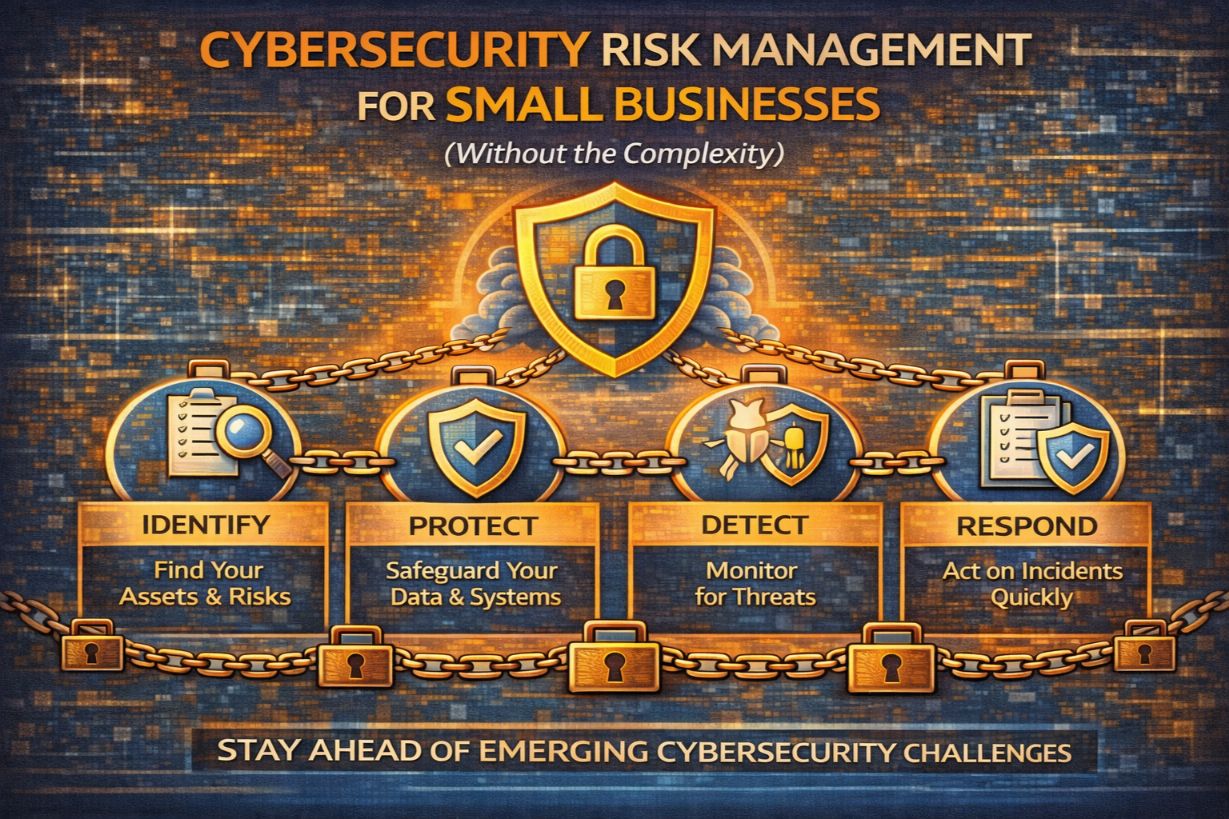
Cybersecurity Risk Management for Small Businesses (Without the Complexity)
Most small businesses either:
- Ignore cyber risk until something breaks, or
- Drown in complex frameworks they never fully implement
Both approaches fail.
Cybersecurity risk management is not about predicting every attack or building perfect defenses. It’s about making structured, repeatable decisions under uncertainty—so incidents don’t turn into existential crises.
This article explains how small businesses should approach cybersecurity risk management, what actually matters, what can be simplified, and how to turn cyber risk from a vague fear into a manageable business input.
Why “Risk Management” Feels Intimidating to SMBs
Risk management sounds like:
- Consultants
- Spreadsheets
- Heat maps
- Jargon
SMBs assume it requires:
- Dedicated staff
- Enterprise tooling
- Excessive time
It doesn’t.
At its core, risk management is simply deciding what you care about, what could hurt it, and what you’re willing to do about it.
The Most Important Shift: Stop Asking “Are We Secure?”
That question is unanswerable.
Instead, ask:
- “What could realistically hurt us?”
- “How bad would that be?”
- “How likely is it?”
- “How quickly would we notice?”
- “How well could we recover?”
These questions drive action.
What Cyber Risk Actually Is (SMB Definition)
Cyber risk =
Likelihood × Impact × Detection Speed × Recovery Capability
Most SMBs focus only on likelihood.
That’s a mistake.
You can’t control attackers.
You can control detection and recovery.
The 4 Core Components of Cyber Risk Management
You don’t need dozens of categories.
You need four.
1. Identify What Matters Most
Start with business impact, not systems.
Ask:
- What processes generate revenue?
- What systems support those processes?
- What data would cause the most damage if lost or exposed?
This creates a critical asset list.
Most SMBs protect everything equally—and fail.
2. Identify Realistic Threat Scenarios
Ignore Hollywood hacking.
For SMBs, realistic scenarios include:
- Phishing leading to email takeover
- Ransomware encrypting shared files
- Cloud account compromise
- Vendor access abuse
- Accidental data deletion
If a scenario is common and damaging, it belongs on the list.
3. Evaluate Impact Honestly
Impact is not abstract.
Impact includes:
- Downtime duration
- Revenue loss
- Payroll disruption
- Legal exposure
- Customer churn
Leadership must define what’s unacceptable, not just inconvenient.
4. Decide How to Treat Each Risk
Every risk has four options:
- Reduce (add controls)
- Transfer (insurance)
- Accept (documented)
- Avoid (change behavior)
Doing nothing is still a decision—it’s just undocumented.
Why SMB Risk Management Fails in Practice
Common reasons:
- Everything is labeled “high risk”
- No owner is assigned
- Decisions aren’t documented
- Reviews never happen
Risk management fails when it becomes theoretical.
A Simple Risk Register SMBs Can Actually Maintain
You don’t need a GRC platform.
A simple register includes:
- Asset or process
- Risk scenario
- Impact level
- Current controls
- Decision (reduce/accept/etc.)
- Owner
- Review date
If it can’t fit in a spreadsheet, it’s too complex.
Detection and Response: The Most Ignored Risk Multipliers
Two SMBs can face the same attack.
The difference:
- One detects in minutes
- One detects in weeks
Detection speed often matters more than prevention.
Risk management must include:
- Monitoring capability
- Escalation clarity
- Response readiness
Why “Accepting Risk” Is Not Negligence
Accepting risk is valid when:
- Impact is low
- Cost of mitigation is high
- Controls would disrupt operations
The key is intentional acceptance, not ignorance.
Documented acceptance protects leadership.
Risk Management and Cyber Insurance
Insurance is not a risk strategy by itself.
Insurance:
- Transfers some financial risk
- Does not reduce downtime
- Does not restore trust
Risk management determines what insurance should cover—and what it can’t.
Risk Management vs Compliance
Compliance asks:
- “Did we meet requirements?”
Risk management asks:
- “Are we exposed to unacceptable harm?”
Risk management should drive compliance decisions—not the reverse.
How Often SMBs Should Revisit Cyber Risk
At minimum:
- Annually
- After major system changes
- After incidents
- After regulatory changes
Risk that isn’t reviewed drifts into irrelevance.
Leadership’s Role in Cyber Risk Management
Leadership must:
- Define unacceptable outcomes
- Approve risk acceptance
- Fund risk reduction
- Review posture periodically
This cannot be delegated entirely to IT.
Common SMB Risk Blind Spots
- Vendor access
- Backup integrity
- Identity abuse
- Insider mistakes
- Over-permissioned users
These are boring—and dangerous.
A Realistic Example: Risk-Based Decision
Scenario:
- Cloud email compromise risk
- Impact: high
- Likelihood: moderate
Decision:
- Enforce MFA everywhere
- Add login monitoring
- Accept residual risk
This is risk management—not tool shopping.
Risk Management as a Continuous Loop
Effective risk management is iterative:
- Identify
- Decide
- Implement
- Monitor
- Review
It’s not a one-time exercise.
Why Risk Management Reduces Anxiety
Risk management:
- Replaces fear with structure
- Replaces guessing with decisions
- Replaces chaos with priorities
It doesn’t eliminate uncertainty—but it tames it.
What Good SMB Risk Management Looks Like
- Few, clear priorities
- Documented decisions
- Regular review
- Leadership involvement
- Focus on detection and recovery
It’s boring—and that’s a compliment.
Cyber Risk Is a Leadership Input, Not a Mystery
Cyber risk doesn’t require clairvoyance.
It requires discipline.
Small businesses that manage risk intentionally:
- Spend more efficiently
- Recover faster
- Sleep better
Those that don’t:
- Guess
- React
- Regret
Next Steps
To improve cyber risk management:
- Identify critical assets
- Define unacceptable outcomes
- Build a simple risk register
- Assign ownership
- Review annually
You can’t control attackers.
You can control decisions.