
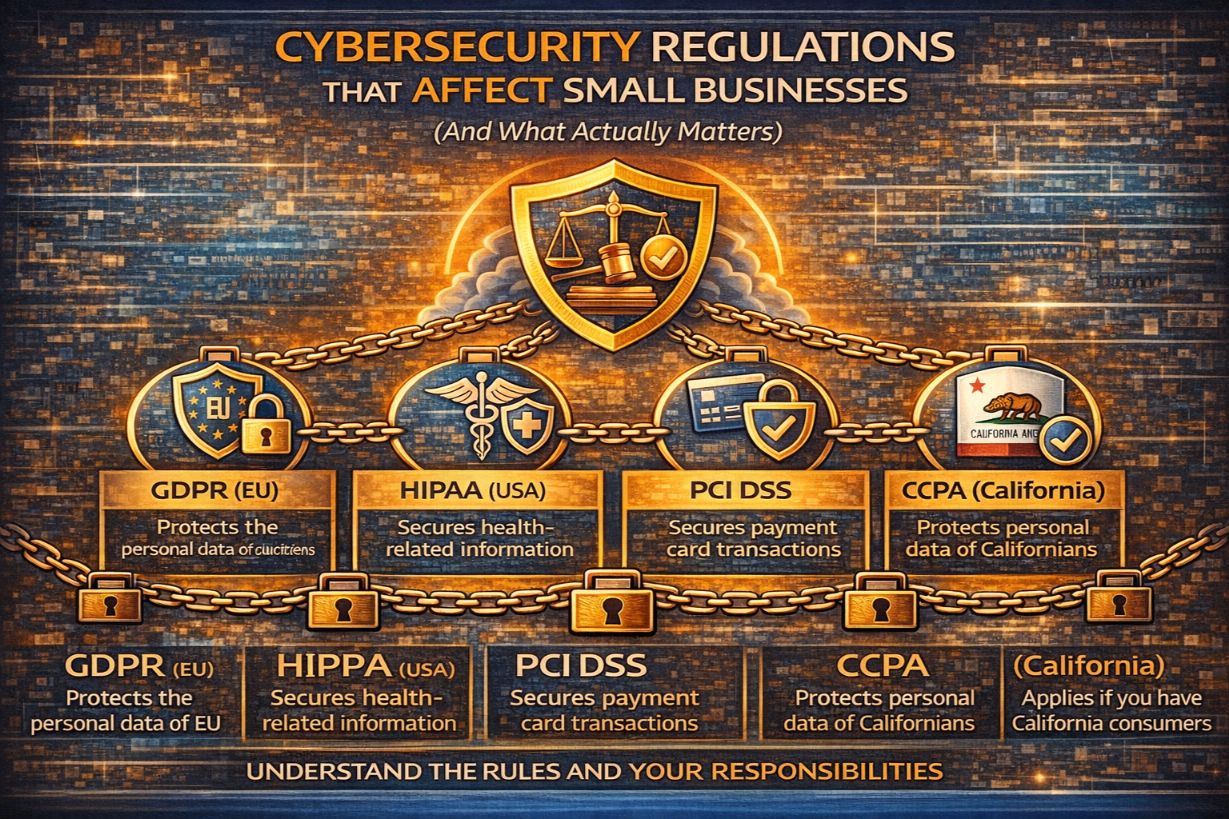
Cybersecurity Regulations That Affect Small Businesses (And What Actually Matters)
Ask ten small business owners which cybersecurity regulations apply to them, and you’ll get ten different answers—most of them wrong.
Some SMBs assume:
- “Regulations are only for big companies”
Others assume:
- “We must comply with everything”
Both assumptions are dangerous.
The reality is more nuanced: most SMBs are regulated in some way, but very few need enterprise-grade compliance programs. The real risk isn’t missing every regulation—it’s misunderstanding which ones apply and responding irrationally.
This article explains which cybersecurity regulations affect small businesses, how applicability actually works, and how to stay compliant without overengineering security or underestimating exposure.
Why Cybersecurity Regulations Confuse SMBs
Regulatory confusion exists because:
- Laws are written broadly
- Requirements are risk-based, not prescriptive
- Applicability depends on data, not company size
- Enforcement often happens after incidents
Regulations rarely say:
“Do these exact 10 technical things.”
They say:
“Use reasonable safeguards appropriate to your risk.”
That ambiguity pushes responsibility onto leadership.
The Most Important Rule: Data Determines Regulation
Cybersecurity regulations are triggered by:
- What data you handle
- Who you do business with
- Where your customers live
Not by:
- Number of employees
- Revenue size
- Industry reputation
Small businesses are regulated because of data, not scale.
The Big Categories of Cybersecurity Regulation for SMBs
Most SMB regulatory exposure falls into five buckets.
1. FTC Safeguards Rule (U.S.)
Applies to:
Many businesses handling consumer financial information—including:
- Professional services
- Tax preparers
- Financial advisors
- Loan processors
What it requires:
- Written security program
- Risk assessment
- Access controls
- Monitoring and testing
- Incident response planning
This rule now explicitly applies to many SMBs.
Key point: “Reasonable security” must be demonstrable.
2. State Data Privacy & Breach Notification Laws
Every U.S. state has breach notification laws.
Common requirements:
- Notify affected individuals
- Notify state authorities
- Meet strict timelines
Some states (like CA, NY) also require:
- Documented security controls
- Risk-based safeguards
You cannot opt out based on size.
3. Industry-Specific Regulations (Conditional)
Examples:
- HIPAA → healthcare data
- PCI DSS → payment card data
- GLBA → financial institutions
You are regulated only if you handle the data, not because of your business label.
Many SMBs are regulated indirectly through clients or vendors.
4. Contractual & Vendor-Driven Requirements
Often more aggressive than law.
Examples:
- Client security questionnaires
- Vendor security addendums
- Cyber insurance conditions
Failure to meet these can mean:
- Lost contracts
- Insurance denial
- Liability exposure
These obligations are enforceable—even if not “law.”
5. International Privacy Regulations (Limited but Growing)
If you handle data of:
- EU residents → GDPR
- UK residents → UK GDPR
Applicability depends on:
- Data subjects
- Services offered
- Marketing reach
Many SMBs overestimate this risk—but some underestimate it badly.
What Regulations Generally Do NOT Require
Most SMB regulations do not require:
- Specific vendors
- Enterprise SOCs
- Zero-day protection
- Military-grade encryption
They require:
- Risk awareness
- Reasonable safeguards
- Ongoing diligence
Regulators judge reasonableness, not perfection.
Why “We Didn’t Know” Doesn’t Work Anymore
Regulators increasingly ask:
- Did leadership assess risk?
- Were controls proportional?
- Were known issues ignored?
Ignorance is not a defense.
Documentation of intent and effort matters.
Common SMB Regulatory Mistakes
Mistake #1: Over-Compliance Panic
Buying:
- Unnecessary tools
- Excessive controls
- Expensive audits
This wastes budget and distracts from real risk.
Mistake #2: Compliance Neglect
Assuming:
- “No one will check”
- “We’re too small”
Most enforcement happens after incidents, not before.
Mistake #3: Treating Compliance as an Annual Event
Compliance is ongoing.
Static documentation decays quickly and weakens defense.
How Regulators Actually Evaluate SMB Security
They look for:
- Evidence of risk assessment
- Reasonable control selection
- Leadership involvement
- Incident response actions
They do not expect:
- Perfection
- Zero incidents
- Enterprise infrastructure
They expect good faith, proportional effort.
Documentation: Your Regulatory Lifeline
Documentation proves:
- Awareness
- Intent
- Due diligence
Key documents every SMB should have:
- Risk assessment summary
- Security policy overview
- Incident response plan
- Vendor risk considerations
Documents don’t stop attacks—but they protect you legally.
Compliance vs Enforcement Reality
Most SMBs encounter regulation when:
- A breach occurs
- A client audits them
- An insurer reviews posture
Preparation determines outcome.
Those with:
- Clear documentation
- Tested response
- Proportional controls
Fare far better—even after incidents.
How Cyber Insurance Changed the Regulatory Landscape
Insurers now act as:
- De facto regulators
- Security gatekeepers
They require:
- MFA
- Backups
- Monitoring
- Incident response readiness
Ignoring insurance requirements creates compliance exposure indirectly.
A Practical Way SMBs Should Approach Regulations
- Identify applicable laws
- Understand intent (not just text)
- Perform a simple risk assessment
- Implement proportional controls
- Document decisions
- Review annually
This balances defensibility and efficiency.
When to Seek Legal vs Security Help
- Security advisors help implement controls
- Legal counsel helps interpret obligations
Avoid using one to replace the other.
The Most Important Regulatory Insight for SMBs
Regulations don’t ask:
“Did you stop every attack?”
They ask:
“Did you act responsibly given what you knew?”
That’s a leadership question—not a technical one.
Regulation Is About Accountability, Not Fear
Cybersecurity regulations exist to:
- Protect consumers
- Assign responsibility
- Enforce minimum standards
They are not designed to bankrupt SMBs.
Small businesses get into trouble when they:
- Ignore obligations
- Overreact emotionally
- Fail to document effort
Reasonable, risk-based security is both compliant and survivable.
Next Steps
To clarify your regulatory exposure:
- Identify data you handle
- Map applicable regulations
- Document a basic security program
- Align controls with real risk
- Review annually or after incidents
Compliance isn’t about being perfect.
It’s about being defensible.