
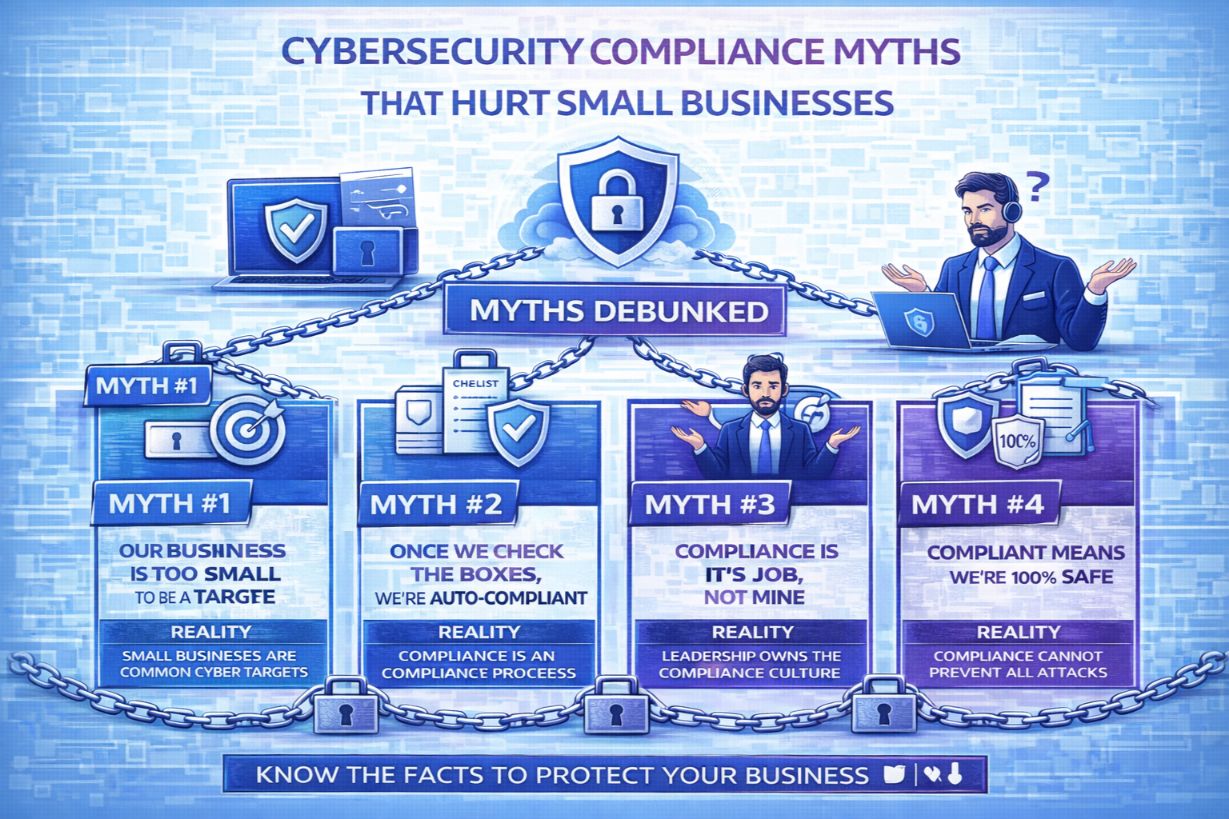
Cybersecurity Compliance Myths That Hurt Small Businesses
Many small businesses believe compliance equals security.
That belief is understandable.
It is also one of the most dangerous assumptions in cybersecurity.
Compliance frameworks, regulations, and audits were never designed to protect businesses from modern cyber threats. They were designed to:
- Establish minimum expectations
- Assign liability
- Demonstrate due diligence
Security failures happen when SMBs treat compliance as the goal instead of a constraint within a broader risk strategy.
This article breaks down the most common cybersecurity compliance myths that actively hurt small businesses, explains why they persist, and shows how to use compliance without being blinded by it.
Why Compliance Feels Like a Safe Shortcut
Compliance is attractive because it:
- Feels concrete
- Provides checklists
- Creates a pass/fail outcome
- Transfers decision-making to an external authority
For SMB leaders under pressure, compliance feels like certainty.
But compliance is not about preventing incidents.
It’s about assigning responsibility after incidents.
Myth #1: “If We’re Compliant, We’re Secure”
This is the most damaging myth.
Compliance answers:
- “Did we meet minimum requirements?”
Security asks:
- “Can we detect and contain an attack before it destroys us?”
Many compliant organizations are breached every year.
Why?
Because attackers don’t care about audit reports.
Myth #2: “Passing an Audit Means We’re Safe”
Audits are:
- Point-in-time
- Narrow in scope
- Dependent on evidence quality
Audits do not:
- Test real-world response
- Simulate attackers
- Validate recovery under pressure
An audit proves documentation existed, not that defenses work.
Myth #3: “Compliance Frameworks Are Security Frameworks”
Frameworks like:
- HIPAA
- PCI DSS
- FTC Safeguards Rule
Were written to:
- Reduce negligence
- Standardize expectations
- Support enforcement
They were not written to:
- Stop ransomware
- Detect credential abuse
- Contain modern attacks
Security frameworks (like NIST CSF, CIS Controls) focus on how attacks happen—compliance frameworks focus on who is responsible.
Myth #4: “If We Check All the Boxes, We’re Done”
Compliance checklists encourage:
- Minimalism
- Static controls
- “Good enough” thinking
Cyber threats are:
- Dynamic
- Adaptive
- Automated
Security decays.
Compliance often assumes stasis.
Myth #5: “Compliance Is an IT Problem”
Compliance failures often stem from:
- Poor leadership oversight
- Undefined risk tolerance
- Weak governance
IT can:
- Implement controls
- Produce evidence
IT cannot:
- Accept business risk
- Define downtime tolerance
- Make legal tradeoffs
Compliance is a business responsibility, not a technical task.
Myth #6: “Regulators Will Tell Us What to Do”
Regulations are intentionally vague.
They say things like:
- “Reasonable safeguards”
- “Appropriate controls”
- “Adequate protection”
This ambiguity shifts responsibility to the business.
Waiting for regulators to define security guarantees underinvestment and weak defenses.
Why Compliance-First Security Fails SMBs
SMBs that lead with compliance tend to:
- Optimize for audits
- Ignore real attack paths
- Underinvest in detection and response
- Overinvest in documentation
This creates paper security.
Paper security collapses under pressure.
Real-World Example: Compliant but Compromised
A typical scenario:
- MFA enabled only where required
- Backups exist but are untested
- Incident response plan exists but unused
- Monitoring minimal
Result:
- Audit passed
- Ransomware still cripples operations
Compliance did not prevent impact.
What Compliance Is Actually Good For
Compliance does provide value when used correctly.
It helps:
- Establish baseline expectations
- Justify minimum investments
- Demonstrate due diligence
- Support insurance and legal defenses
But it must sit under security strategy—not replace it.
Compliance as a Floor, Not a Ceiling
The correct mental model:
Compliance defines the minimum acceptable effort—not the goal.
Security maturity should exceed compliance where:
- Risk is higher
- Impact is unacceptable
- Business dependency is strong
Many SMBs need controls beyond compliance to survive incidents.
How Attackers Exploit Compliance Gaps
Attackers exploit:
- Overly broad access
- Lack of monitoring
- Slow detection
- Poor response coordination
These weaknesses are often outside compliance scope.
Attackers don’t breach policies.
They breach systems.
Compliance and Cyber Insurance: A Dangerous Overlap
Many SMBs assume:
- “If we’re compliant, insurance will cover us.”
Reality:
- Insurance expects operational controls
- Insurers review security posture post-incident
- Compliance alone does not guarantee payout
Security failures invalidate coverage more often than compliance gaps.
The Most Common SMB Compliance Mistakes
- Treating compliance as strategy
- Doing compliance once per year
- Outsourcing compliance without ownership
- Ignoring operational readiness
- Assuming documentation equals protection
These mistakes compound silently.
How SMBs Should Use Compliance Correctly
A healthy approach:
- Understand required regulations
- Meet baseline obligations
- Identify gaps beyond compliance
- Address high-impact risks first
- Revisit continuously
Compliance becomes supporting evidence, not false reassurance.
Compliance vs Risk Management: The Key Difference
Compliance asks:
- “Did we meet requirements?”
Risk management asks:
- “What could hurt us most, and how do we reduce it?”
Security must be driven by risk management.
Compliance should support—not dictate—decisions.
How Leadership Should Frame Compliance Internally
Better framing:
- “This keeps us legally defensible”
- “This is the minimum we must do”
- “This does not guarantee safety”
Bad framing:
- “We’re compliant, so we’re secure”
Language shapes behavior.
Why SMBs Overvalue Compliance
Because:
- It feels objective
- It creates binary outcomes
- It reduces decision anxiety
But false certainty is dangerous.
Security requires judgment.
A Better Model: Security-First, Compliance-Supported
The most resilient SMBs:
- Lead with risk-based security
- Use compliance to validate basics
- Invest in detection and response
- Test recovery regularly
They treat compliance as necessary but insufficient.
Compliance Does Not Protect You—Preparation Does
Compliance helps after incidents.
Preparation helps during incidents.
For small businesses, survival depends on:
- Detection speed
- Response clarity
- Recovery capability
None of those are guaranteed by compliance alone.
Next Steps
To escape compliance traps:
- Review what compliance actually covers
- Identify risks outside scope
- Test incident response and recovery
- Align security with real business impact
Compliance keeps you defensible.
Security keeps you operational.