
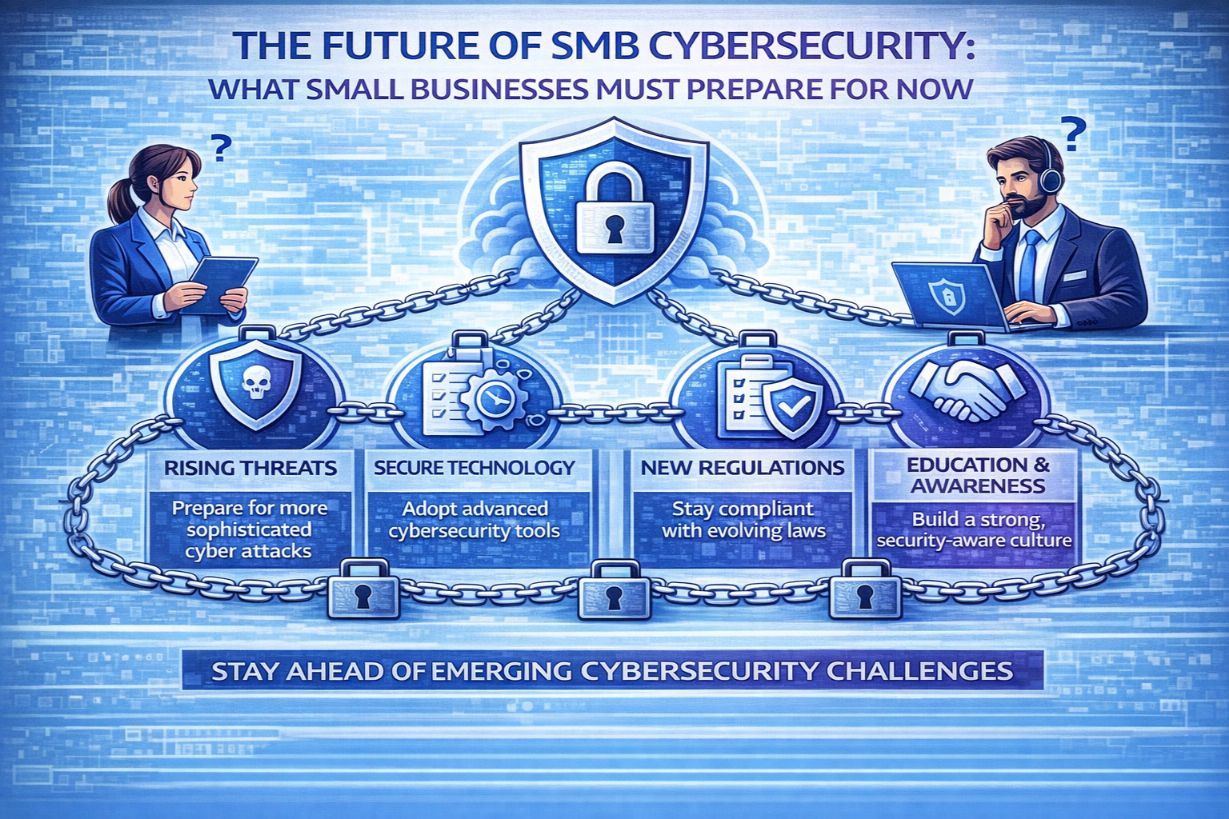
The Future of SMB Cybersecurity: What Small Businesses Must Prepare for Now
The future of cybersecurity is often described in dramatic terms:
- AI super-hackers
- Nation-state attacks
- Zero-day chaos
For small businesses, that framing is mostly noise.
The real future of SMB cybersecurity is quieter—and far more dangerous. It’s about structural shifts that change how attacks happen, how risk accumulates, and how small mistakes cascade into business-ending events.
This article explains what the future of cybersecurity actually looks like for small businesses, what trends matter, what doesn’t, and what SMBs must start preparing for now to remain viable over the next 3–5 years.
The Most Important Insight: SMB Cyber Risk Is Becoming Systemic
Cyber risk is no longer:
- Isolated
- Occasional
- Easily contained
It is becoming:
- Continuous
- Interconnected
- Amplified by dependencies
SMBs are increasingly affected not because they are targeted directly—but because they sit inside complex digital supply chains.
Trend #1: Identity Will Fully Replace the Network
This is not a prediction—it’s already happening.
Firewalls matter less.
Perimeters are gone.
Identity is the control plane.
What this means for SMBs:
- MFA everywhere becomes mandatory, not optional
- Conditional access becomes baseline
- Identity monitoring becomes more important than malware detection
SMBs that fail to harden identity will be breached repeatedly—quietly and cheaply.
Trend #2: Attacks Will Become Cheaper, Faster, and More Automated
Attack sophistication is no longer required.
AI and automation:
- Scale phishing effortlessly
- Generate convincing impersonation
- Exploit misconfigurations at speed
This favors attackers, not defenders.
For SMBs, this means:
- You will not “fly under the radar”
- Generic defenses must be consistent
- Detection speed matters more than prevention depth
The future attacker is not brilliant—it’s relentless.
Trend #3: Ransomware Will Shift From Encryption to Extortion
Encryption is noisy.
Extortion is quiet.
Attackers increasingly:
- Steal data
- Threaten disclosure
- Pressure customers or partners
This bypasses backups entirely.
SMBs must prepare for:
- Data exposure scenarios
- Legal and reputational fallout
- Communication under pressure
Backups alone will not save you.
Trend #4: Vendors Will Be the Primary Attack Vector
Third-party compromise will continue to rise because:
- Vendors have broad access
- Oversight is weak
- Liability is blurred
SMBs will increasingly be breached through someone else.
Future-ready SMBs will:
- Treat vendor access as high-risk by default
- Enforce MFA and least privilege
- Monitor vendor activity continuously
Vendor governance will matter more than vendor trust.
Trend #5: Cyber Insurance Will Become Harder, Stricter, and Less Forgiving
Cyber insurance is evolving rapidly.
Expect:
- Higher premiums
- Stricter underwriting
- Reduced payouts for weak controls
- Post-incident scrutiny
Insurance will increasingly reward:
- Detection capability
- Response readiness
- Documented decision-making
SMBs that treat insurance as a fallback will lose coverage.
Trend #6: Compliance Will Expand—But Not Clarify
Regulations will:
- Grow broader
- Remain vague
- Increase post-incident enforcement
Compliance will not become easier.
It will become more judgment-based.
SMBs must:
- Document intent and effort
- Demonstrate proportional controls
- Show leadership involvement
Checkbox compliance will fail under scrutiny.
Trend #7: Downtime Will Become Less Tolerable
Customer expectations are rising.
Even small disruptions now:
- Trigger churn
- Damage trust
- Go public quickly
The future favors SMBs that can:
- Detect incidents early
- Contain impact
- Communicate clearly
- Recover quickly
Resilience will outperform “strong defenses.”
What Will NOT Matter as Much as Vendors Claim
Let’s be explicit.
For most SMBs, the future is not about:
- Zero-day exploitation
- Advanced nation-state threats
- Exotic malware
- AI-vs-AI arms races
Those are enterprise and geopolitical problems.
SMBs will fail due to:
- Identity abuse
- Over-permissioned access
- Poor visibility
- Slow response
Boring problems cause real damage.
The Structural Shift SMBs Must Accept
The biggest change SMBs must internalize:
Cybersecurity is no longer about preventing incidents—it’s about surviving them predictably.
That changes priorities.
The 5 Capabilities Future-Ready SMBs Must Build
1. Identity Discipline
- MFA everywhere
- No shared accounts
- Minimal admin access
- Continuous review
Identity mistakes will dominate breach statistics.
2. Detection, Not Just Defense
- 24/7 monitoring
- Identity and endpoint visibility
- Clear escalation paths
You can’t respond to what you don’t see.
3. Containment by Design
- Segmented access
- Limited blast radius
- Vendor isolation
Assume compromise—limit damage.
4. Recovery That Actually Works
- Isolated backups
- Tested restores
- Business continuity planning
Recovery speed will define survival.
5. Leadership-Level Ownership
- Defined risk tolerance
- Incident decision authority
- Regular review
Leaderless risk will destroy SMBs faster than hackers.
The Time Horizon That Matters: 3–5 Years
Most SMBs plan:
- 12 months ahead for security
Attackers plan:
- Opportunistically
The future requires:
- Multi-year thinking
- Incremental maturity
- Roadmaps, not reactions
Security that resets annually never compounds.
Why SMBs That “Wait and See” Will Lose
Waiting feels rational.
It isn’t.
Costs of delay:
- Harder insurance renewal
- Higher breach impact
- Loss of client trust
- Reactive spending under stress
Preparation preserves options.
Delay removes them.
What Prepared SMBs Will Look Like in 3 Years
They will:
- Spend more predictably
- Experience fewer catastrophic incidents
- Recover faster when incidents occur
- Win trust with partners and insurers
Security maturity will become a competitive advantage, not just a cost.
What Unprepared SMBs Will Experience
They will:
- Face repeated account takeovers
- Struggle to renew insurance
- Lose clients after incidents
- Spend more under duress
The gap between prepared and unprepared SMBs will widen sharply.
The Strategic Choice SMBs Must Make Now
The choice is not:
- “Secure or insecure”
It is:
- Intentional or accidental
Cybersecurity will exist either way.
The only question is whether it is designed or improvised.
The Future Favors the Calm and Prepared
The future of SMB cybersecurity is not about:
- Fear
- Hype
- Perfect protection
It is about:
- Discipline
- Clarity
- Preparation
- Leadership
Small businesses that survive the next decade will not be the ones with the most tools.
They will be the ones that:
- Detect early
- Respond decisively
- Recover predictably
- Learn continuously
That future starts now.
Final Next Steps
To prepare for the future:
- Harden identity everywhere
- Invest in detection and response
- Control vendor access
- Test recovery realistically
- Build a multi-year roadmap
Cybersecurity maturity isn’t built in emergencies.
It’s built before they happen.