
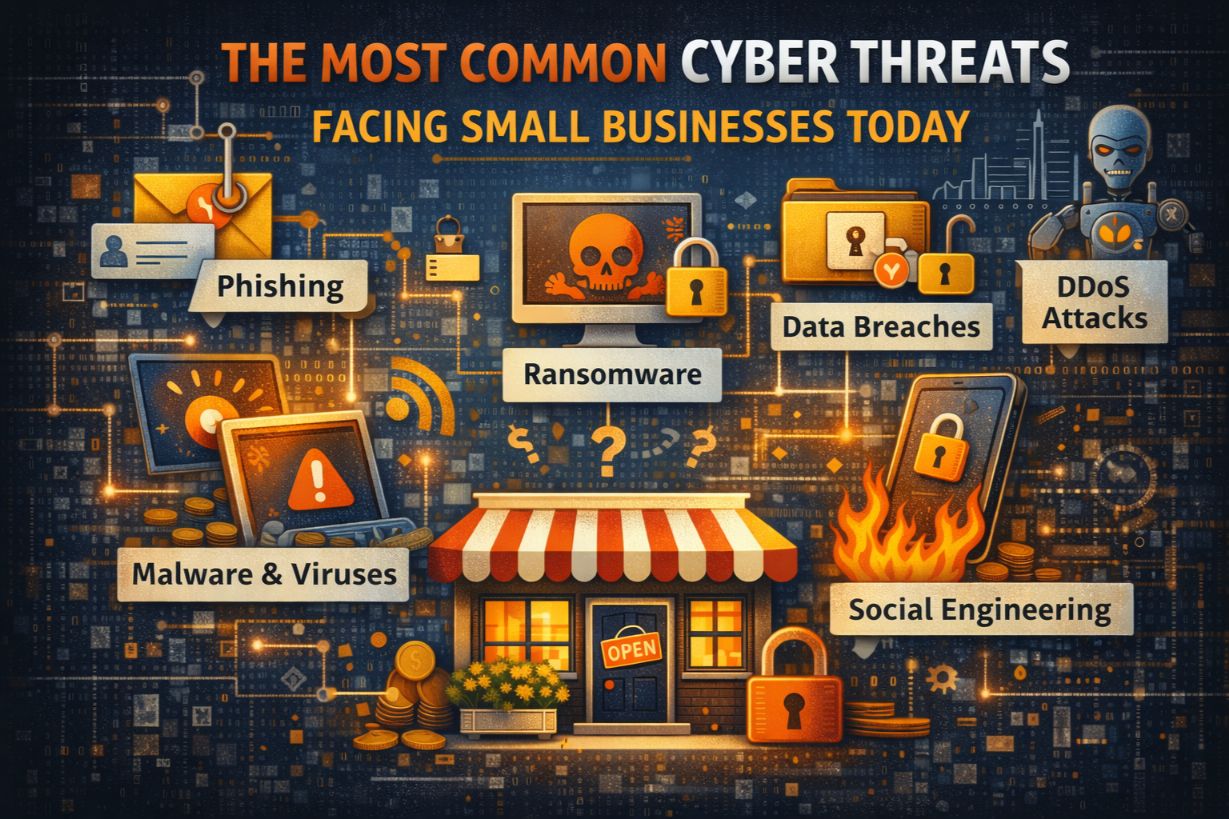
The Most Common Cyber Threats Facing Small Businesses Today
Cyber threats don’t announce themselves.
They don’t knock. They don’t warn. And they don’t discriminate based on company size.
For small businesses, cyber threats are no longer rare events—they’re constant background pressure. Automated attacks scan the internet every minute, looking for exposed systems, weak credentials, and untrained employees.
This guide breaks down the most common cyber threats facing small businesses today, how those attacks actually work, and why SMBs are disproportionately impacted when something goes wrong.
Understanding these threats is the first step to stopping them.
Why Small Businesses Face a Different Threat Landscape
Small businesses are targeted not because they’re valuable—but because they’re efficient.
Attackers prefer SMBs because:
- Security controls are weaker
- Monitoring is limited or nonexistent
- Response is slower
- Downtime is more damaging
- Employees are less trained
Most cyber threats are designed to exploit predictable SMB weaknesses, not advanced enterprise defenses.
1. Phishing Attacks: The Gateway Threat
Phishing remains the most common and successful cyber threat against small businesses.
How Phishing Works
Attackers send emails designed to:
- Look legitimate
- Create urgency
- Imitate vendors, executives, or platforms
- Trick users into clicking links or opening attachments
Once a user interacts:
- Credentials are stolen
- Malware is installed
- Access is granted silently
Phishing is effective because it attacks people, not systems.
Why SMBs Are Vulnerable
- Limited employee training
- No phishing simulations
- Basic email filtering
- High trust environments
It only takes one employee to compromise an entire business.
2. Ransomware: The Business Killer
Ransomware encrypts files and demands payment for decryption.
For SMBs, ransomware is often catastrophic.
Why Ransomware Hits SMBs Harder
- Limited backups
- No incident response plan
- Downtime halts revenue
- Recovery costs exceed reserves
Modern ransomware groups:
- Steal data before encryption
- Destroy backups
- Threaten public exposure
Paying the ransom doesn’t guarantee recovery—and often invites repeat attacks.
3. Business Email Compromise (BEC)
BEC attacks don’t use malware.
They use trust.
How BEC Attacks Work
Attackers:
- Compromise or spoof email accounts
- Monitor conversations
- Insert themselves at the right moment
- Request wire transfers or payment changes
These attacks often bypass technical controls because:
- The email looks legitimate
- The request appears routine
- The timing feels right
BEC is one of the most financially damaging cyber threats to SMBs.
4. Credential Theft and Account Takeover
Stolen credentials are the backbone of many attacks.
Credentials are stolen through:
- Phishing
- Malware
- Password reuse
- Data breaches on unrelated sites
Once attackers have credentials, they:
- Log in legitimately
- Move laterally
- Avoid detection
- Escalate privileges
If MFA isn’t enforced, credentials alone are enough.
5. Malware and Trojans
Malware is no longer loud or obvious.
Modern malware:
- Runs quietly
- Avoids detection
- Uses legitimate system tools
- Persists over time
Common malware goals include:
- Credential harvesting
- Remote access
- Data exfiltration
- Ransomware deployment
SMBs relying on outdated antivirus are especially exposed.
6. Supply Chain Attacks
Small businesses are increasingly targeted as entry points.
Attackers compromise SMBs to:
- Access larger partners
- Steal shared credentials
- Move laterally across trust relationships
Examples include:
- IT service providers
- Accounting firms
- Software vendors
- Contractors
Your cybersecurity affects more than just your business.
7. Insider Threats (Accidental and Intentional)
Not all threats come from outside.
Insider threats include:
- Employees clicking phishing links
- Weak password practices
- Data mishandling
- Disgruntled staff abusing access
Most insider incidents are accidental—but the impact is the same.
Without access controls and monitoring, insider risks go unnoticed.
8. Cloud Misconfigurations
Cloud platforms are secure—but only when configured properly.
Common SMB cloud risks include:
- Publicly accessible storage
- Over-permissioned users
- No MFA
- No activity logging
Misconfiguration is one of the leading causes of SMB data breaches.
9. Remote Work Exploits
Remote and hybrid work expanded the attack surface dramatically.
Attackers target:
- Home networks
- Personal devices
- Unsecured Wi-Fi
- Shadow IT tools
Without endpoint security and access controls, remote work becomes a liability.
Why Most SMB Cyber Threats Go Undetected
Small businesses often don’t detect attacks because:
- No centralized logging
- No monitoring tools
- No alerting processes
- No defined response roles
Many SMBs only discover breaches after:
- Data is encrypted
- Money is stolen
- Customers are impacted
Detection delay increases damage exponentially.
How Cyber Threats Escalate Inside Small Businesses
Most attacks follow a predictable pattern:
- Initial access (phishing or credentials)
- Privilege escalation
- Lateral movement
- Persistence
- Data theft or encryption
Stopping attacks early dramatically reduces impact.
Why Cyber Threats Keep Working Against SMBs
Cyber threats succeed not because defenses don’t exist—but because:
- They aren’t implemented consistently
- They aren’t monitored
- They aren’t tested
- They aren’t prioritized
Attackers exploit gaps between assumptions and reality.
Reducing Exposure to Common Cyber Threats
Small businesses don’t need perfect security—but they do need baseline controls.
Key risk reducers include:
- MFA everywhere
- Email security enhancements
- Endpoint detection
- Regular patching
- Employee training
- Backup validation
- Basic monitoring
These steps eliminate most low-effort attacks.
Cyber Threats Are a Business Reality—Not an IT Problem
Cyber threats don’t just impact systems.
They impact:
- Revenue
- Operations
- Reputation
- Legal standing
- Customer trust
Ignoring cyber threats doesn’t make them go away.
It just removes your ability to respond.
Awareness Is the First Defense Layer
Cyber threats are not hypothetical for small businesses.
They are:
- Active
- Automated
- Persistent
- Profitable
Understanding the most common cyber threats is not about fear—it’s about preparation.
The businesses that survive cyber incidents are not the ones with the most tools.
They’re the ones that understand their risks and act before attackers force the issue.
Next Steps
If you want to know which threats matter most to your business:
- Conduct a cyber risk assessment
- Review email and access controls
- Evaluate detection and response readiness
You can’t stop what you don’t see—but you can reduce your exposure dramatically.