
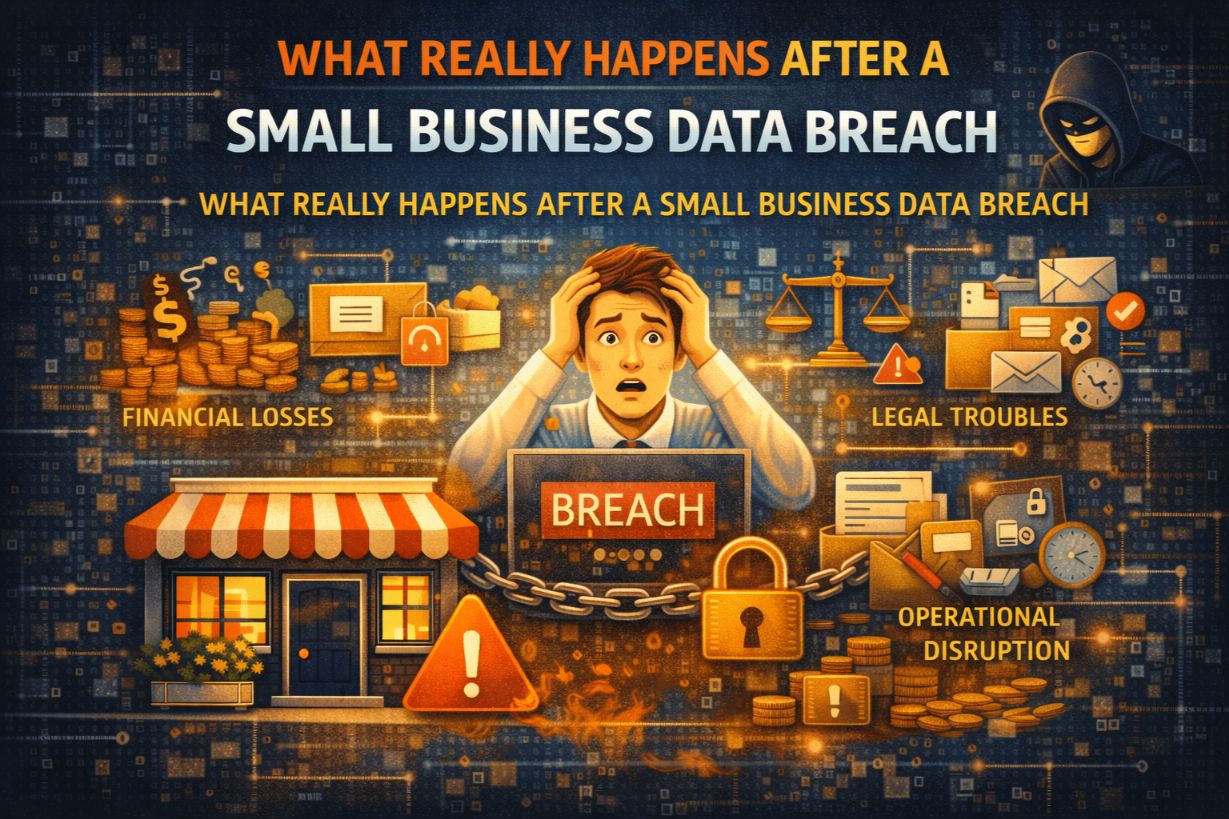
What Really Happens After a Small Business Data Breach
Most small business owners think a data breach is a technical problem.
It’s not.
A data breach is a business crisis—legal, financial, operational, and reputational—all at once. And for small businesses, the aftermath is often far more damaging than the breach itself.
This article walks through what actually happens after a small business data breach, step by step. Not the theory. Not the vendor-friendly version. The real sequence of events SMBs face when customer data is exposed.
If you understand this before a breach, you have options.
If you learn it after, those options disappear quickly.
Step 1: The Breach Is Discovered (Usually Late)
Contrary to popular belief, most SMBs do not discover breaches themselves.
Common discovery scenarios include:
- A customer reports suspicious activity
- A bank flags fraudulent transactions
- A vendor or partner notifies you
- Systems suddenly stop working
- Files are encrypted by ransomware
In many cases, attackers have had access for:
- Weeks
- Months
- Sometimes longer
By the time the breach is discovered, data is already gone.
Step 2: Confusion, Panic, and Unclear Ownership
The first hours after discovery are chaotic.
Common SMB reactions:
- “Is this real?”
- “What systems are affected?”
- “Who do we call?”
- “Should we shut everything down?”
Most small businesses:
- Don’t have an incident response plan
- Don’t know who is responsible
- Don’t know what evidence to preserve
This confusion increases damage and delays containment.
Step 3: Immediate Operational Impact
Even breaches that don’t involve ransomware cause disruption.
Common impacts include:
- Email shutdowns
- Cloud access revocation
- Password resets across the business
- System outages during investigation
- Employees unable to work
Revenue-generating activities often stop or slow dramatically.
For SMBs, downtime equals cash flow stress.
Step 4: Forensic Investigation Begins (If You’re Lucky)
To understand what happened, businesses often need:
- Incident response specialists
- Digital forensics
- Log analysis
- System imaging
This process determines:
- How attackers got in
- What data was accessed
- How long they were present
- Whether access is still active
Without logs and monitoring, answers may be incomplete—or impossible.
Step 5: Legal Obligations Are Triggered
This is where many SMBs are blindsided.
Once customer data may have been exposed, you may be legally required to:
- Notify affected individuals
- Notify regulators
- Notify partners or clients
- Meet strict reporting timelines
Failure to comply can lead to:
- Fines
- Lawsuits
- Contractual penalties
Breach notification laws apply regardless of company size.
Step 6: Lawyers Get Involved (Immediately)
Data breaches are legal events.
Businesses often need:
- Privacy attorneys
- Regulatory guidance
- Contract review
- Breach notification drafting
Legal costs escalate quickly—and they start early.
Trying to “handle it quietly” often makes things worse.
Step 7: Customers Are Notified (And They React)
Breach notifications are required—but they have consequences.
Customer reactions often include:
- Loss of trust
- Contract cancellations
- Negative reviews
- Public complaints
- Increased scrutiny
Even if the breach was small, perception matters.
For SMBs, reputation damage can be fatal.
Step 8: Insurance Reality Sets In
Many SMBs assume cyber insurance will save them.
Reality is harsher.
Insurance claims may be:
- Delayed
- Partially denied
- Denied entirely
Common denial reasons include:
- Missing MFA
- Outdated systems
- Lack of security controls
- Policy exclusions
Insurance helps if requirements were met before the breach.
Step 9: Financial Costs Accumulate Fast
Data breach costs extend far beyond IT cleanup.
Common expenses include:
- Incident response services
- Legal fees
- Notification and mailing costs
- Credit monitoring for customers
- System rebuilding
- Lost revenue
- Increased insurance premiums
For many SMBs, these costs exceed cash reserves.
Step 10: Leadership and Staff Fallout
Breaches strain internal relationships.
Common outcomes:
- Leadership blame
- Employee anxiety
- Burnout
- Turnover
- Loss of confidence
Without clear communication, morale collapses.
Step 11: Increased Scrutiny From Everyone
After a breach, SMBs face:
- Customer audits
- Partner security questionnaires
- Regulatory follow-ups
- Insurance reassessments
What was once “good enough” is no longer acceptable.
Security expectations increase permanently.
Step 12: Long-Term Business Impact
The long tail of a data breach is often underestimated.
Long-term effects include:
- Lost customers
- Slower sales cycles
- Increased compliance costs
- Higher operating expenses
- Reputation rebuilding
Some SMBs never fully recover market trust.
Why Small Businesses Struggle More Than Enterprises
Large enterprises have:
- Dedicated response teams
- Legal departments
- PR firms
- Cash reserves
Small businesses have:
- Limited staff
- Limited capital
- Limited time
- Limited margin for error
The same breach impacts SMBs more severely and more permanently.
Common SMB Mistakes After a Data Breach
- Delaying professional help
- Not preserving evidence
- Communicating inconsistently
- Assuming insurance will cover everything
- Trying to resume operations too quickly
- Failing to fix root causes
Post-breach mistakes often cause more damage than the breach itself.
How Preparation Changes the Outcome
Prepared SMBs:
- Detect breaches faster
- Contain damage sooner
- Meet legal obligations
- Reduce downtime
- Retain more customers
Preparation doesn’t eliminate pain—but it prevents collapse.
What “Breach Readiness” Actually Means
Breach readiness includes:
- Incident response plan
- Clear roles and escalation paths
- Contact lists (legal, IT, insurance)
- Logging and monitoring
- Backup and recovery testing
It’s not about fear—it’s about control.
Why Most SMBs Wait Too Long
Many SMBs avoid breach planning because:
- It feels pessimistic
- It feels expensive
- It feels unlikely
But breaches don’t ask permission.
They happen on the attacker’s timeline—not yours.
The Breach Is the Beginning, Not the End
The real damage of a small business data breach doesn’t happen at the moment of compromise.
It happens in the days, weeks, and months after—when decisions are rushed, information is incomplete, and options are limited.
Small businesses that survive breaches don’t rely on luck.
They rely on preparation.
Next Steps
To reduce the impact of a potential data breach:
- Create an incident response plan
- Review legal and notification requirements
- Ensure logging and monitoring are active
- Validate backups and recovery timelines
The time to plan for a breach is before one happens