
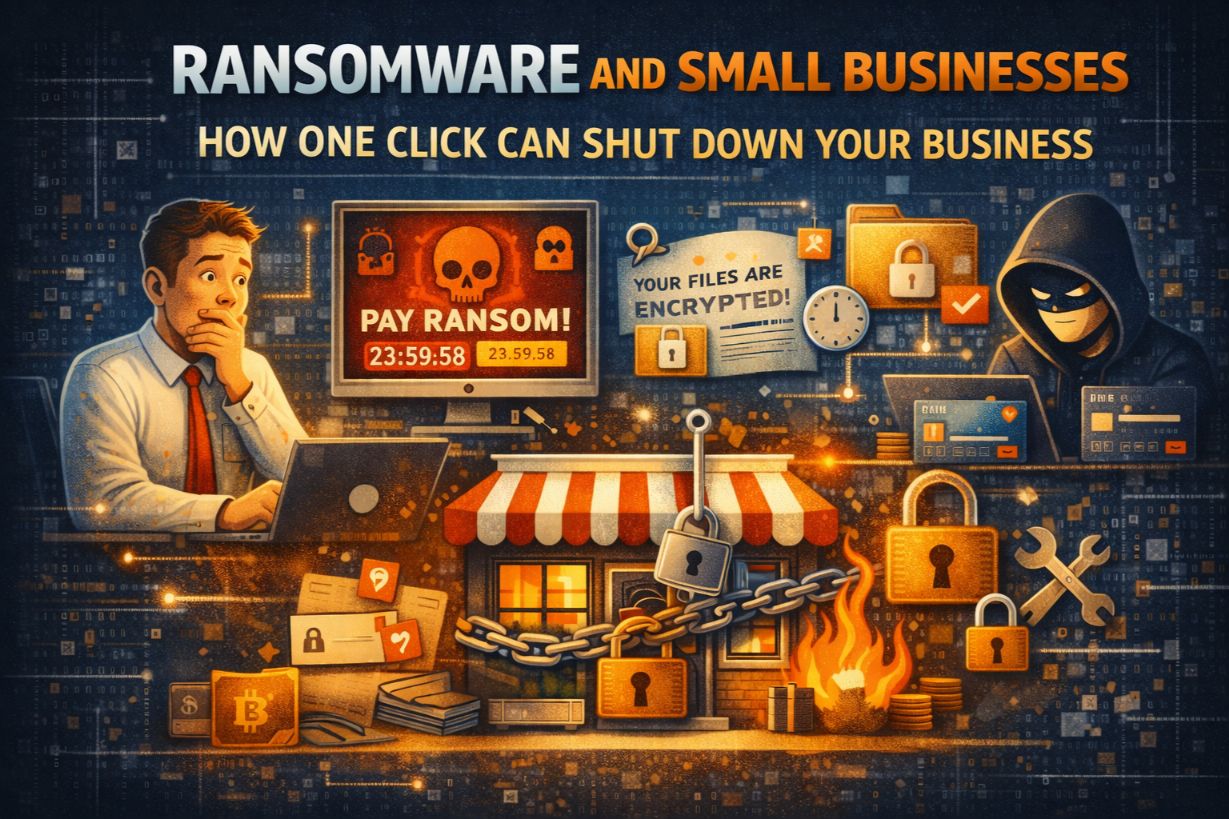
Ransomware and Small Businesses: How One Click Can Shut Down Your Business
Ransomware doesn’t care how hard you worked to build your business.
It doesn’t care how loyal your customers are.
It doesn’t care how thin your margins already are.
It only cares about one thing: how quickly you’ll pay to get your business back.
For small businesses, ransomware isn’t just another cyber threat—it’s often a business-ending event. One click. One compromised account. One missed backup. That’s all it takes.
This article explains how ransomware attacks on small businesses actually happen, why SMBs are prime targets, what attackers do after they get in, and how to avoid becoming the next headline—or worse, the next closure.
What Is Ransomware (Really)?
Ransomware is malware that:
- Encrypts files and systems
- Disables access to data and applications
- Demands payment (usually in cryptocurrency) for recovery
But modern ransomware has evolved.
Today’s ransomware attacks also include:
- Data theft (double extortion)
- Public leak threats
- Backup destruction
- Repeated targeting after payment
You’re not just paying to restore files.
You’re paying to protect your reputation—and sometimes that still doesn’t work.
Why Small Businesses Are Prime Ransomware Targets
Attackers target SMBs because:
- Security controls are weaker
- Detection is slower
- Downtime is catastrophic
- Cash flow pressure forces fast decisions
Large enterprises negotiate.
Small businesses panic.
Ransomware groups know this—and price demands accordingly.
The Myth That Fuels Ransomware Attacks
“We have backups, so ransomware won’t hurt us.”
This myth has destroyed thousands of SMBs.
Attackers now:
- Locate backups first
- Encrypt or delete them
- Steal data before encryption
- Target cloud backups and connected storage
If backups aren’t isolated, immutable, and tested, they are not protection.
How Ransomware Attacks Actually Start in SMBs
Ransomware almost never starts with someone “hacking the network.”
It starts with basic failures.
1. Phishing Emails
The most common ransomware entry point.
An employee:
- Opens a malicious attachment
- Clicks a fake link
- Enters credentials
That’s it.
Once credentials are stolen, ransomware is deployed after attackers establish persistence.
2. Stolen or Weak Credentials
If attackers obtain credentials and:
- MFA is not enforced
- Admin privileges are excessive
They can deploy ransomware without malware detection ever triggering.
This is why antivirus alone fails.
3. Unpatched Systems
Outdated software and known vulnerabilities are still exploited daily.
Attackers scan continuously for:
- Unpatched VPNs
- Unsupported operating systems
- Legacy remote access tools
SMBs with delayed patching are easy prey.
4. Remote Desktop Protocol (RDP) Exposure
Open or poorly secured RDP is a ransomware magnet.
If RDP is:
- Exposed to the internet
- Protected only by passwords
Attackers will find it.
What Attackers Do Before Ransomware Is Deployed
This is the part most SMBs never see.
Modern ransomware attacks involve pre-encryption staging.
Attackers:
- Gain initial access
- Escalate privileges
- Disable security tools
- Locate backups
- Steal sensitive data
- Identify critical systems
- Deploy ransomware everywhere at once
By the time encryption starts, the damage is already done.
Why Ransomware Is So Devastating for SMBs
1. Immediate Operational Shutdown
When systems go down:
- Sales stop
- Billing stops
- Communication stops
- Customer service collapses
Many SMBs cannot operate manually for more than a day or two.
2. Data Loss Isn’t Always Recoverable
Even with backups:
- Restore times may be weeks
- Data may be corrupted
- Systems may require rebuilding
Some data is lost permanently.
3. Legal and Regulatory Fallout
If customer data is stolen:
- Breach notification laws apply
- Legal exposure increases
- Compliance penalties may follow
Ransomware isn’t just technical—it’s legal.
4. Reputation Damage
Customers may forgive mistakes.
They don’t forgive silence, chaos, or repeated incidents.
Trust is fragile—and ransomware shatters it fast.
5. Insurance Doesn’t Always Save You
Cyber insurance is not a guarantee.
Policies may:
- Deny claims due to control gaps
- Limit ransomware payments
- Require proof of safeguards
- Exclude certain attack types
Many SMBs discover coverage issues after the incident.
Why Paying the Ransom Is a Gamble
Paying does not guarantee:
- Full decryption
- Data deletion
- No future attacks
Some SMBs pay and:
- Receive faulty decryptors
- Are targeted again
- Still face data leaks
Attackers mark paying victims as high-value future targets.
Why Antivirus Fails Against Ransomware
Traditional antivirus looks for known malware signatures.
Ransomware today:
- Uses legitimate admin tools
- Executes fileless attacks
- Deploys payloads late
- Avoids detection entirely
Without behavior-based detection and monitoring, ransomware slips through silently.
How SMBs Can Actually Defend Against Ransomware
You don’t need enterprise defenses—but you do need intentional controls.
1. Enforce MFA Everywhere
This alone stops a massive percentage of ransomware attacks.
Especially on:
- VPNs
- Admin accounts
- Cloud platforms
2. Secure Backups Properly
Effective ransomware backups must be:
- Isolated from production systems
- Immutable or write-protected
- Monitored
- Tested regularly
A backup you haven’t tested is a liability.
3. Reduce Privileged Access
Ransomware spreads faster when:
- Everyone is an admin
- Access is unrestricted
Least-privilege access dramatically limits damage.
4. Patch Aggressively
Known vulnerabilities should never be your downfall.
Delayed patching is an open invitation.
5. Monitor for Early Indicators
Ransomware gives off warning signs:
- Suspicious logins
- Security tool tampering
- Unusual file access
- Backup access attempts
Early detection turns disasters into recoverable incidents.
Ransomware Is a Business Continuity Issue
Ransomware isn’t just about files.
It’s about:
- Whether you can operate tomorrow
- Whether customers trust you next week
- Whether your business survives the year
Treating ransomware as “just another IT risk” is how SMBs fail.
Ransomware Preys on Assumptions
Ransomware succeeds when businesses assume:
- “It won’t happen to us”
- “Our backups are fine”
- “Antivirus will catch it”
- “Insurance will cover it”
Those assumptions are expensive.
Preparation is cheaper.
Next Steps
If ransomware would cripple your business:
- Review backup isolation and testing
- Enforce MFA immediately
- Evaluate endpoint detection and monitoring
- Build a basic ransomware response plan
Hope is not a strategy.
Preparation is