
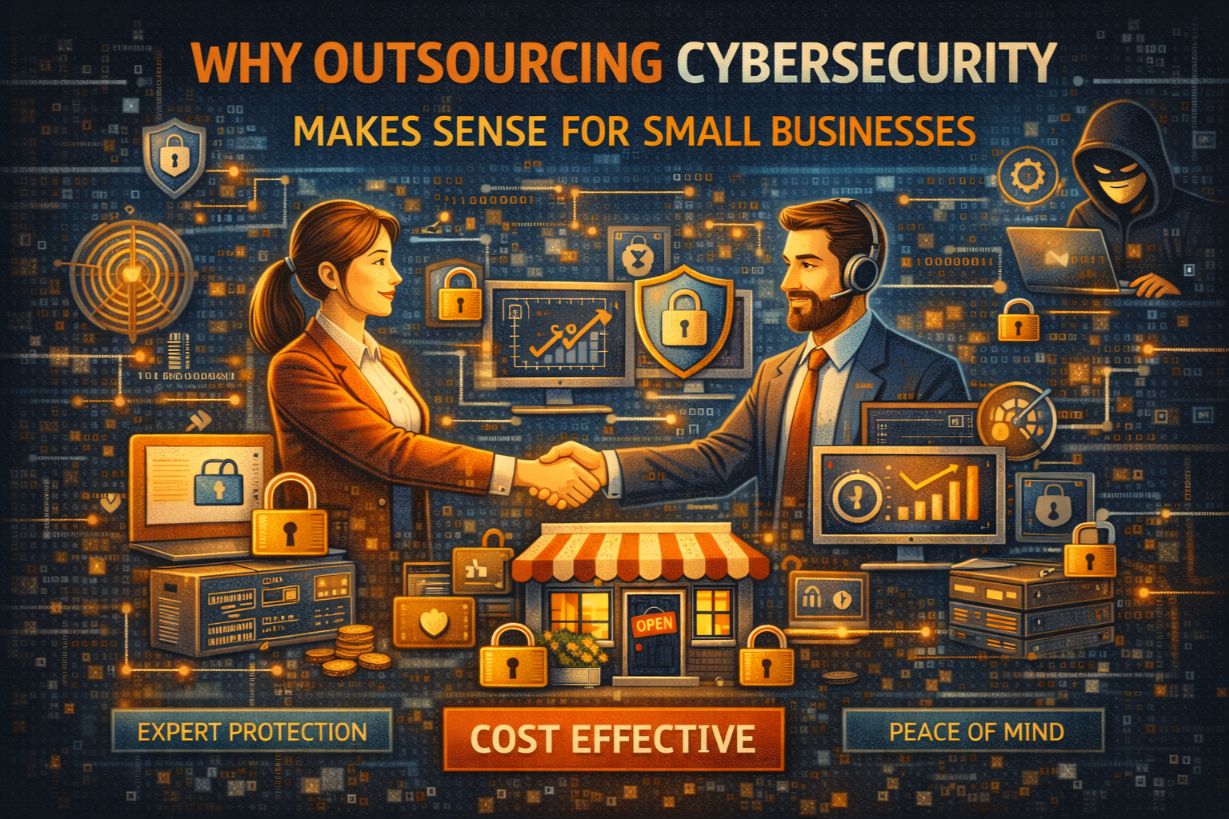
Why Outsourcing Cybersecurity Makes Sense for Small Businesses
For many small business owners, outsourcing cybersecurity feels like admitting defeat.
There’s a strong instinct to believe:
- “We should be able to handle this ourselves”
- “Outsourcing means losing control”
- “Security should live in-house”
That instinct is understandable—and increasingly dangerous.
Modern cybersecurity is not a static IT function. It is an adversarial, 24/7 discipline that rewards specialization, speed, and scale. For most SMBs, trying to manage cybersecurity entirely in-house is not a sign of strength—it’s a structural disadvantage.
This article explains why outsourcing cybersecurity makes sense for small businesses, when it’s the right move, what it actually delivers, and how to outsource without giving up control.
Cybersecurity Is No Longer an Internal Skillset Problem
In the past, IT and security were tightly coupled.
Today, they are not.
Modern cybersecurity requires:
- Continuous monitoring
- Threat intelligence
- Incident response expertise
- Tool tuning and correlation
- Adversary-aware thinking
This is not something a generalist IT role can realistically handle on top of daily operations.
Outsourcing exists because the skill and time requirements outpaced internal capacity.
The Economics of In-House Cybersecurity for SMBs
Let’s talk reality—not theory.
To run even a basic internal security operation, you need:
- Skilled security analysts
- Coverage outside business hours
- Multiple tools and licenses
- Ongoing training
- Process and documentation
The fully loaded cost of one qualified security analyst often exceeds what many SMBs spend on all IT combined.
And one analyst still doesn’t provide 24/7 coverage.
Outsourcing converts this impossible staffing problem into a shared-cost model.
Outsourcing Does Not Mean Abdicating Responsibility
This is a critical distinction.
Outsourcing cybersecurity does not mean:
- You stop caring about security
- You lose visibility
- You give up decision-making
It means:
- You delegate execution to specialists
- You retain oversight and authority
- You gain leverage you couldn’t afford alone
Security responsibility remains with the business.
Security operations are shared.
Why SMBs Are Structurally Disadvantaged In-House
SMBs face structural constraints that outsourcing solves.
Time
Attacks don’t happen on a schedule.
Internal teams do.
Attention
Security competes with revenue-generating work.
Outsourced teams focus on security only.
Scale
Attackers reuse techniques at scale.
Defenders must match scale to keep up.
Burnout
One person “owning security” leads to exhaustion and blind spots.
Outsourcing absorbs these pressures.
What Outsourced Cybersecurity Actually Delivers
Done correctly, outsourced cybersecurity provides more than tools.
1. Continuous Threat Detection
Outsourced providers monitor:
- Endpoints
- Cloud activity
- Network behavior
This closes the most common SMB gap: no one watching.
2. Faster Incident Response
Speed matters more than perfection.
Outsourced teams:
- Triage alerts immediately
- Investigate suspicious behavior
- Escalate confirmed threats
- Assist with containment
Minutes matter. Outsourcing buys time.
3. Expertise You Could Never Hire Internally
Outsourced teams bring:
- Threat hunters
- Incident responders
- Security engineers
- Analysts trained across industries
You benefit from collective experience, not a single perspective.
4. Mature Processes SMBs Rarely Build
Most SMBs lack:
- Incident runbooks
- Escalation paths
- Evidence handling procedures
Outsourced providers already have these in place.
5. Predictable Costs
Outsourcing converts:
- Variable, emergency-driven spending
Into - Predictable monthly costs
This makes budgeting realistic.
Why “We’ll Build It Later” Rarely Works
Many SMBs plan to:
- Hire security later
- Improve controls later
- Formalize processes later
Later often arrives after an incident, when:
- Options are limited
- Costs are higher
- Pressure is extreme
Outsourcing allows SMBs to act before that moment.
Common SMB Objections to Outsourcing (And the Reality)
“We’ll Lose Control”
You lose control when you don’t know what’s happening.
Outsourcing increases visibility, not reduces it.
“They Won’t Understand Our Business”
Good providers learn your environment.
Bad providers are replaceable.
This is a vendor selection issue—not a model flaw.
“It’s Too Expensive”
Compare outsourcing to:
- One breach
- One denied insurance claim
- One week of downtime
Outsourcing is often cheaper than not outsourcing.
“Our IT Team Can Handle It”
IT teams are not adversary-focused by default.
Security requires:
- Constant vigilance
- Specialized training
- Attack-centric thinking
Outsourcing complements IT—it doesn’t replace it.
Outsourcing vs. Buying More Tools
Many SMBs respond to risk by buying tools.
This often results in:
- Alert overload
- Poor configuration
- No response ownership
Outsourcing aligns tools with people and process.
Security tools without operators are noise generators.
When Outsourcing Is Especially Valuable for SMBs
Outsourcing cybersecurity is particularly effective when:
- You handle sensitive data
- You have compliance obligations
- You rely heavily on cloud services
- You operate with lean staff
- Downtime would cripple operations
For many SMBs, this is the norm—not the exception.
What to Look for in an Outsourced Cybersecurity Partner
Key criteria:
- 24/7 monitoring (not “on-call”)
- Clear response SLAs
- Plain-language communication
- Incident ownership clarity
- SMB experience
Red flags include:
- Vague promises
- No response guarantees
- Tool-only offerings
Outsourcing works when accountability is explicit.
Outsourcing and Cyber Insurance Alignment
Insurers increasingly reward:
- Managed detection and response
- Documented incident response
- Continuous monitoring
Outsourcing can:
- Improve underwriting outcomes
- Reduce exclusions
- Strengthen claim defensibility
Security maturity affects insurability.
Outsourcing Is About Reducing Blast Radius
No defense is perfect.
The goal is:
- Detect early
- Contain quickly
- Recover predictably
Outsourcing shortens detection and response time—dramatically.
That alone reduces damage.
The Strategic Truth SMBs Must Accept
Cybersecurity is not a competitive advantage.
It is a survivability requirement.
Outsourcing does not mean weakness.
It means:
- Choosing leverage over pride
- Choosing preparedness over hope
- Choosing resilience over fragility
Strong businesses outsource intelligently.
Control Is About Outcomes, Not Ownership
Owning every function doesn’t make a business strong.
Controlling outcomes does.
For small businesses, outsourcing cybersecurity is often the most effective way to:
- Reduce risk
- Improve response
- Control costs
- Preserve optionality
Cyber threats don’t reward self-reliance.
They punish isolation.
Next Steps
To evaluate outsourced cybersecurity:
- Compare in-house vs outsourced costs honestly
- Identify detection and response gaps
- Review insurance and compliance requirements
- Assess current alert ownership
The question isn’t whether you can do security alone.
It’s whether you can afford to.