
NIST Cybersecurity Framework Explained for Small Businesses
The NIST Cybersecurity Framework is one of the most widely referenced security frameworks in the world—and one of the most misunderstood by small businesses.
Mention “NIST” to an SMB owner and the reaction is often:
- “That’s for enterprises”
- “That’s government-level security”
- “We don’t have the resources for that”
Those reactions are understandable—and mostly wrong.
The NIST Cybersecurity Framework (NIST CSF) was designed to be flexible, scalable, and adaptable, making it one of the best frameworks for small businesses—if used correctly.
This article explains what the NIST Cybersecurity Framework is, how SMBs should use it, what to ignore, and how to apply it without drowning in documentation or unnecessary controls.
What the NIST Cybersecurity Framework Actually Is
The NIST CSF is not a checklist.
It is not a certification.
It is not a compliance mandate (for most SMBs).
The NIST CSF is a risk-based structure for organizing cybersecurity activities around business outcomes.
It answers a simple question:
“How well are we managing cyber risk today—and where should we improve next?”
Why the NIST Framework Works for SMBs (When Used Correctly)
The NIST CSF was built with:
- Different organization sizes in mind
- Different risk tolerances
- Different resource constraints
It does not prescribe tools.
It does not require perfection.
It does not demand enterprise bureaucracy.
It helps SMBs:
- Prioritize controls
- Align security with business risk
- Communicate security clearly to leadership, insurers, and partners
The Five Core Functions of NIST (In Plain English)
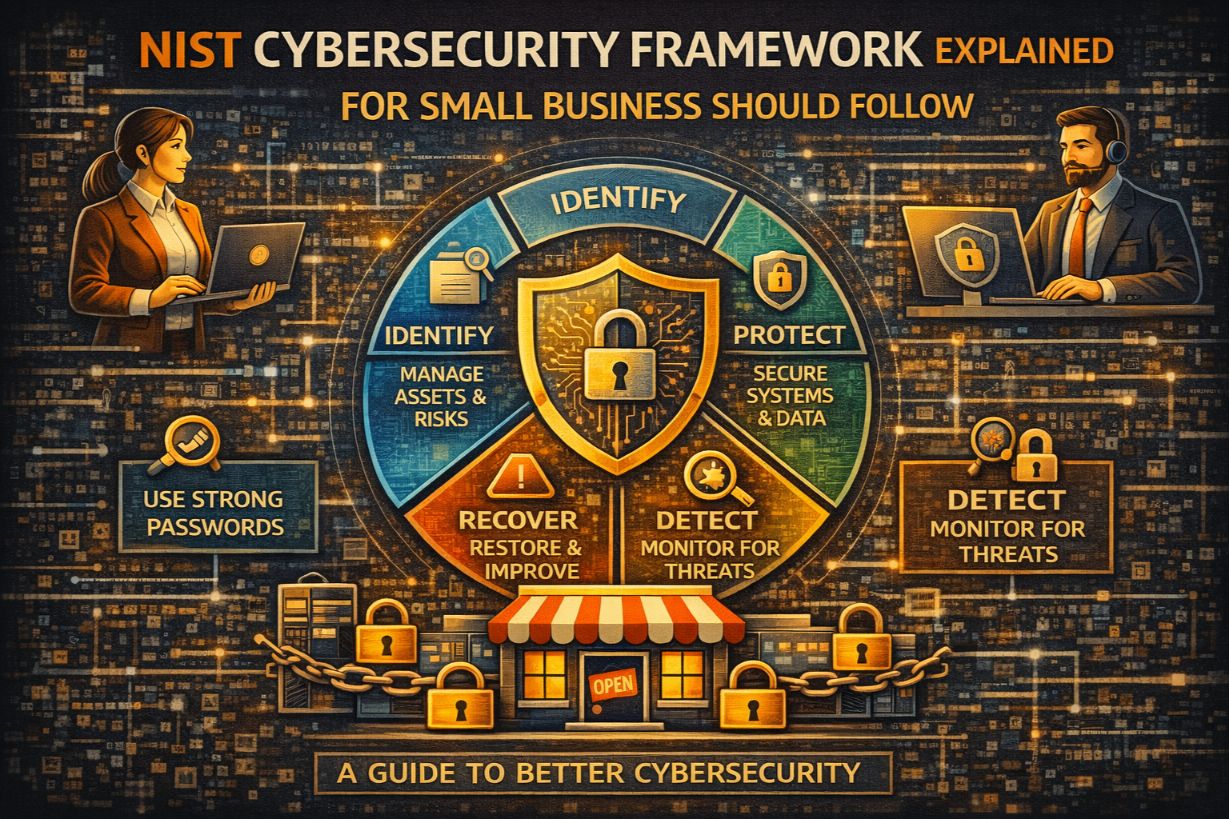
The NIST CSF is organized into five core functions.
Think of these as phases of cyber risk management, not technical silos.
1. Identify – Know What Matters and What’s at Risk
This function is about understanding your business.
Key questions:
- What systems do we rely on?
- What data would hurt us most if lost or exposed?
- Who has access?
- What vendors touch our environment?
For SMBs, Identify often exposes:
- Unknown data sprawl
- Excessive access
- Untracked vendor dependencies
This function is foundational—and often skipped.
2. Protect – Put Basic Safeguards in Place
Protect focuses on preventive controls.
This includes:
- MFA
- Access control
- Encryption
- Patch management
- Security awareness training
For SMBs, Protect is about blocking common attacks, not elite threats.
Most real-world SMB breaches happen because Protect controls were incomplete or inconsistent.
3. Detect – Know When Something Is Wrong
Detect is where many SMBs fall down.
This function includes:
- Security monitoring
- Log review
- Alerting
- Anomaly detection
If you don’t know something is happening, response is impossible.
Detect turns incidents from surprises into manageable events.
4. Respond – Act Decisively When Incidents Occur
Respond focuses on containment and coordination, not panic.
It includes:
- Incident response planning
- Communication procedures
- Decision authority
- Evidence handling
For SMBs, Respond doesn’t mean a war room.
It means knowing who does what when things go wrong.
5. Recover – Get Back to Business
Recover is about resilience, not just restoration.
It includes:
- Backup restoration
- Business continuity planning
- Lessons learned
- Process improvement
Recovery is where SMBs either stabilize—or spiral.
Why SMBs Get the NIST Framework Wrong
Common mistakes include:
- Treating it like a compliance checklist
- Trying to implement everything at once
- Over-documenting
- Buying tools to “cover” framework categories
- Ignoring business context
NIST is a lens, not a shopping list.
NIST Is About Maturity, Not Completion
The NIST CSF recognizes maturity levels.
SMBs are not expected to:
- Match enterprise security
- Eliminate all risk
- Implement every control
They are expected to:
- Know their current state
- Define a target state
- Improve over time
Progress beats perfection.
How SMBs Should Actually Use the NIST Framework
Here’s the right way to apply NIST as an SMB.
Step 1: Map What You Already Do
Most SMBs already perform some NIST activities—even if informally.
Examples:
- You already have backups (Recover)
- You already manage user access (Protect)
- You already respond to IT issues (Respond)
Documenting existing efforts builds momentum and clarity.
Step 2: Identify High-Risk Gaps
Use NIST to ask:
- Where would an incident hurt us most?
- Where do we lack visibility?
- Which functions are weakest?
For many SMBs, Detect and Respond are the biggest gaps.
Step 3: Prioritize by Business Impact
Don’t improve everything.
Improve:
- What protects revenue
- What protects customer trust
- What reduces downtime
NIST supports prioritization—it doesn’t override it.
Step 4: Use NIST to Justify Decisions
NIST provides a neutral reference point.
It helps SMBs:
- Defend security budgets
- Explain decisions to leadership
- Respond to insurance questionnaires
- Answer customer security questions
This is one of its biggest advantages.
NIST vs Other Frameworks for SMBs
NIST CSF stands out because it is:
- Free
- Flexible
- Non-prescriptive
- Widely recognized
Compared to:
- ISO 27001 (heavy and certification-driven)
- CIS Top 18 (control-focused but less strategic)
NIST is often the best organizing framework for SMBs.
What NIST Does NOT Require SMBs to Do
Important clarification:
- No certification
- No audits (unless required separately)
- No specific tools
- No massive documentation
If someone tells you NIST requires these, they’re overselling.
How NIST Helps with Cyber Insurance and Compliance
Insurers and regulators often ask:
- Do you follow a recognized framework?
- How do you assess and manage risk?
Using NIST:
- Improves underwriting conversations
- Strengthens defensibility
- Demonstrates due diligence
It shows you’re acting responsibly—even if you’re not perfect.
NIST Without Execution Is Useless
A framework without action is just a diagram.
NIST only works if:
- Gaps are addressed
- Improvements are tracked
- Ownership is assigned
Frameworks don’t reduce risk—people and decisions do.
Common SMB Trap: Over-Engineering NIST
You do not need:
- NIST consultants for months
- Dozens of policies
- Endless meetings
You need:
- Honest self-assessment
- Focused improvements
- Consistent execution
Simple done well beats complex ignored.
Practical NIST Example for an SMB
Example priority alignment:
- Identify: Document critical systems and data
- Protect: Enforce MFA on email and cloud
- Detect: Implement 24/7 monitoring
- Respond: Create a 1-page incident response plan
- Recover: Test backups quarterly
That alone dramatically improves posture.
NIST Is a Map, Not the Journey
The NIST Cybersecurity Framework doesn’t secure your business.
It helps you decide how to secure your business.
For small businesses, that clarity is invaluable.
Used correctly, NIST:
- Prevents wasted effort
- Aligns security with risk
- Improves communication
- Strengthens resilience
Used incorrectly, it becomes noise.
Next Steps
To apply NIST effectively:
- Perform a simple NIST-based self-assessment
- Identify top 5 risk gaps
- Prioritize improvements by business impact
- Revisit progress annually
Frameworks don’t protect businesses.
Execution does.