
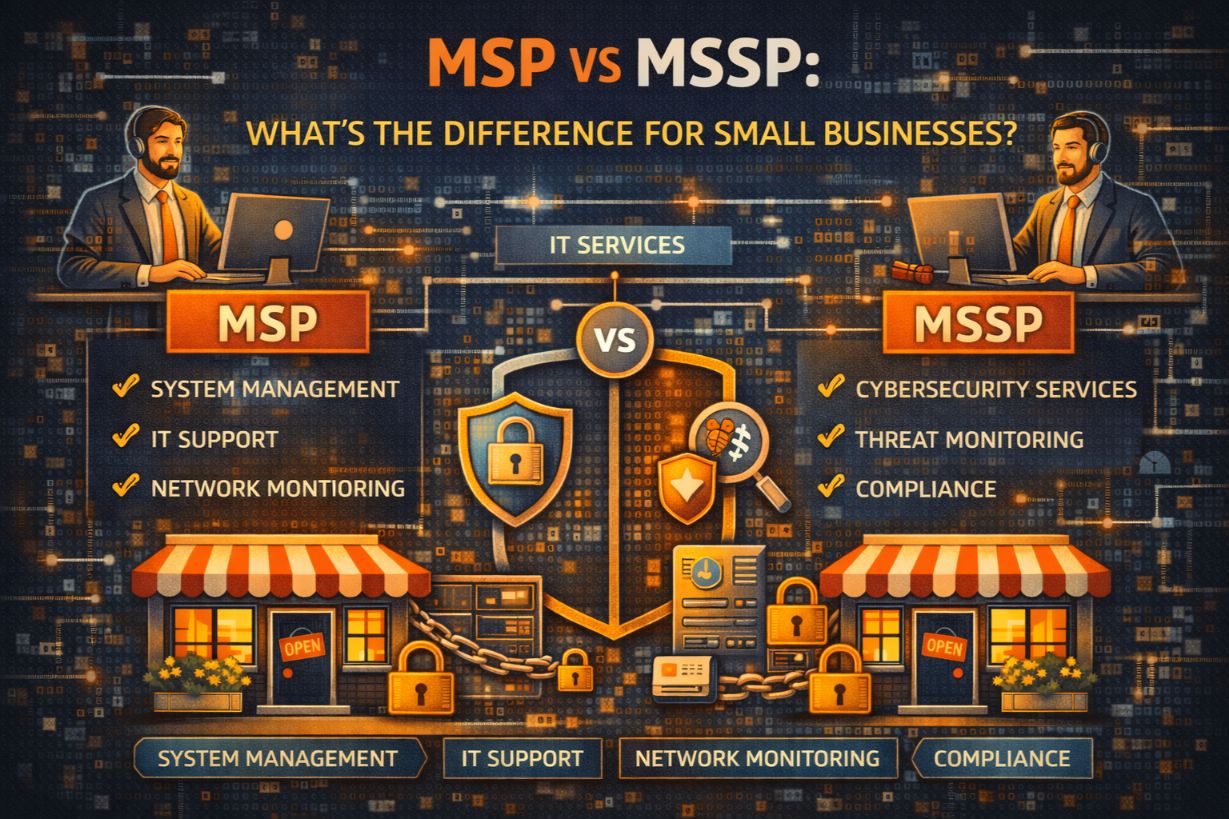
MSP vs MSSP: What’s the Difference for Small Businesses?
One of the most common—and most expensive—assumptions small businesses make is this:
“Our MSP handles security.”
In many cases, that assumption is wrong.
Managed Service Providers (MSPs) and Managed Security Service Providers (MSSPs) play very different roles, and confusing the two leaves dangerous gaps in detection, response, and accountability.
This article explains the difference between MSP vs MSSP for small businesses, what each actually does, where overlap exists, and why SMBs often believe they are protected when they are not.
Why This Confusion Exists in the First Place
The confusion is understandable.
Both MSPs and MSSPs:
- Use technical tools
- Manage systems
- Talk about “security”
- Sell ongoing services
But their core missions are not the same.
MSPs focus on keeping systems running.
MSSPs focus on stopping attackers.
Those are related—but not interchangeable—goals.
What an MSP Actually Does for Small Businesses
A Managed Service Provider is primarily responsible for IT operations.
Typical MSP responsibilities include:
- Helpdesk and user support
- Device setup and maintenance
- Patch management
- Backups (sometimes)
- Network and server uptime
- Software updates
MSPs are designed to keep technology functional and predictable.
Their success metrics are:
- Uptime
- Ticket resolution time
- System availability
Security is often one component of a broader IT service—not the focus.
What an MSSP Actually Does for Small Businesses
A Managed Security Service Provider focuses specifically on cyber threats.
Typical MSSP responsibilities include:
- 24/7 security monitoring
- Threat detection and investigation
- Incident response
- Endpoint Detection & Response (EDR)
- Email threat response
- Security alert triage
Their success metrics are:
- Detection speed
- Containment time
- Reduced dwell time
- Reduced impact
MSSPs assume attackers are present—and plan accordingly.
The Core Difference: Reactive vs Adversarial Thinking
This is the most important distinction.
MSP Thinking:
- “Is the system working?”
- “Is the server up?”
- “Did the update install?”
MSSP Thinking:
- “Is this behavior malicious?”
- “Is this login suspicious?”
- “Is someone trying to move laterally?”
MSPs manage systems.
MSSPs manage threats.
Where MSPs and MSSPs Overlap (And Where They Don’t)
There is some overlap—but it’s limited.
| Area | MSP | MSSP |
| Patch management | ✔️ | ⚠️ (monitored, not executed) |
| Antivirus | ✔️ | ❌ (insufficient alone) |
| Endpoint security | ⚠️ | ✔️ (behavior-based) |
| Monitoring | ⚠️ (uptime) | ✔️ (threat activity) |
| Incident response | ❌ | ✔️ |
| Threat hunting | ❌ | ✔️ |
| Compliance reporting | ⚠️ | ✔️ |
Many MSPs provide baseline security hygiene—not active defense.
The Most Dangerous Assumption SMBs Make
“If something bad happens, our MSP will catch it.”
Often:
- No one is watching logs
- No one is monitoring login behavior
- No one is correlating alerts
- No one is on call at 2 a.m.
When attacks happen outside business hours, nothing happens—until damage is visible.
That delay is costly.
Why MSPs Rarely Offer True 24/7 Security Monitoring
It’s not negligence—it’s economics.
True security operations require:
- Skilled analysts
- Shift coverage
- Constant alert review
- Threat intelligence
Most MSPs:
- Are not staffed for 24/7 security
- Cannot afford SOC operations
- Focus on operational efficiency
Security at that level requires specialization.
“But Our MSP Installed Security Tools…”
Tools ≠ security.
Installing:
- Antivirus
- Firewalls
- Spam filters
Does not mean:
- Alerts are monitored
- Threats are investigated
- Incidents are contained
Many breaches occur despite tools being installed—because no one was watching.
Real-World SMB Breach Pattern
This pattern appears repeatedly:
- MSP installs tools
- Alerts trigger
- Alerts go unseen
- Attacker persists
- Damage escalates
- Business discovers breach late
The gap is not tools.
It’s response ownership.
Can an MSP Also Be an MSSP?
Yes—but cautiously.
Some providers offer:
- Combined MSP + MSSP services
- Co-managed security models
- Partnerships with SOC providers
What matters is not the label—it’s whether:
- 24/7 monitoring exists
- Threats are investigated
- Response is guaranteed
- SLAs are defined
If those answers aren’t clear, assume the gap exists.
Questions SMBs Should Ask Their MSP Right Now
If you work with an MSP, ask:
- Who monitors security alerts at night and on weekends?
- What happens when a suspicious login occurs?
- Who investigates phishing incidents?
- How quickly are incidents escalated?
- Who owns incident response decisions?
Vague answers are red flags.
Why SMBs Need Both MSP and MSSP Functions
MSPs and MSSPs solve different problems.
- MSPs keep systems usable
- MSSPs keep businesses survivable
Many SMBs benefit from:
- MSP for IT operations
- MSSP for security operations
This separation improves accountability.
How This Confusion Impacts Cyber Insurance and Compliance
Insurers increasingly ask:
- Who monitors your environment?
- Is monitoring 24/7?
- Who responds to incidents?
“Our MSP handles security” is no longer sufficient.
Compliance frameworks also expect:
- Active monitoring
- Incident response capability
Without MSSP-level functions, coverage and compliance suffer.
The Cost of Getting This Wrong
Confusing MSPs with MSSPs leads to:
- Late breach detection
- Larger incidents
- Insurance disputes
- Compliance failures
- Business disruption
This mistake is not theoretical—it’s one of the most common SMB failure points.
How SMBs Should Decide What They Need
Ask:
- Do we need uptime or threat detection—or both?
- Can our current provider deliver 24/7 monitoring?
- Who is accountable during an incident?
Security responsibility must be explicit—not assumed.
IT Support Is Not Cyber Defense
MSPs are valuable.
MSSPs are necessary.
Small businesses don’t lose to cyber threats because they lack IT support.
They lose because no one is actively defending them.
Understanding the difference between MSP vs MSSP is not semantics.
It’s the difference between availability and survivability.
Next Steps
To clarify your security coverage:
- Review MSP contracts for security scope
- Identify who monitors threats 24/7
- Conduct a security gap assessment
- Consider MSSP or co-managed security models
Assumptions are expensive.
Clarity is protective.