
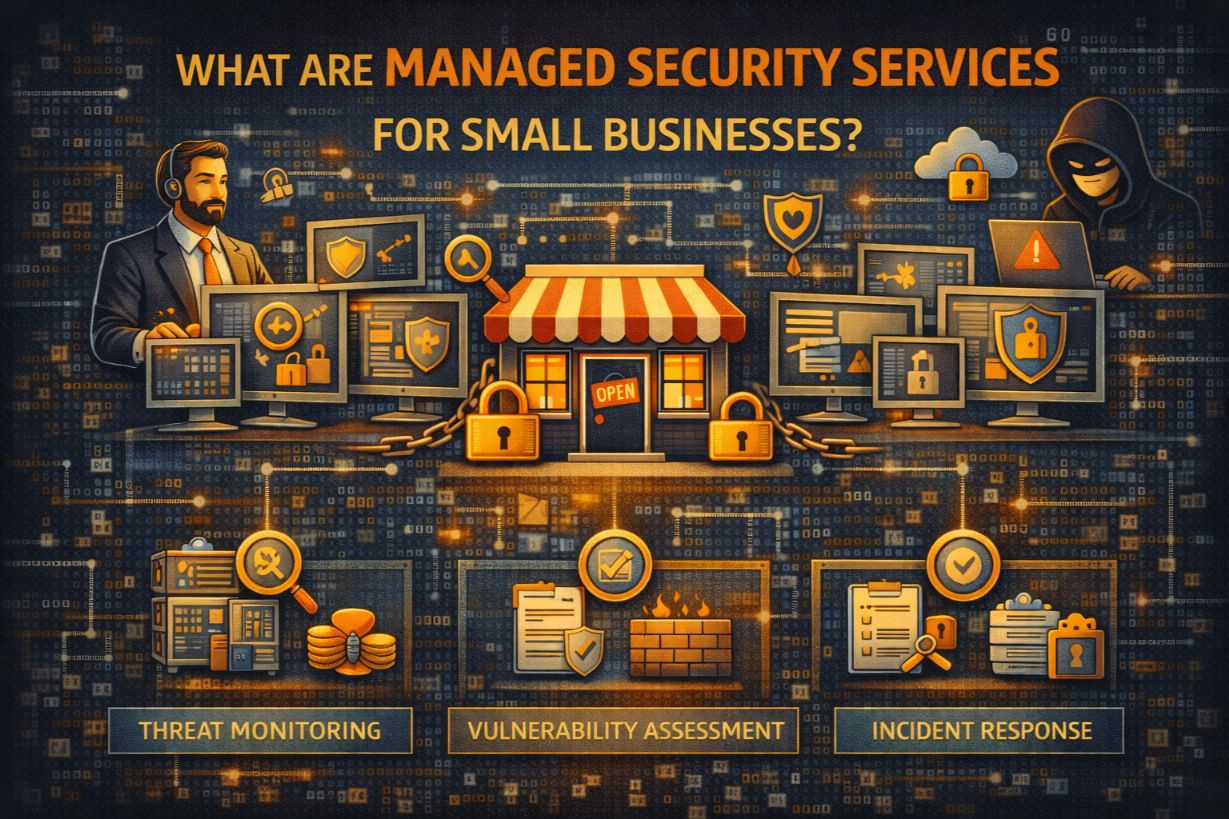
What Are Managed Security Services for Small Businesses?
Most small businesses don’t fail at cybersecurity because they don’t care.
They fail because they try to do security alone—with limited staff, limited time, and limited visibility into fast-moving threats.
Managed Security Services exist because modern cybersecurity is:
- Continuous
- Adversarial
- Time-sensitive
- Too complex for part-time attention
For SMBs, managed security services are not a luxury. They are often the only realistic way to achieve meaningful protection.
This article explains what managed security services are, what they include, what they don’t, and how small businesses should evaluate whether outsourcing security makes sense.
What Are Managed Security Services (MSS)?
Managed Security Services involve outsourcing some or all cybersecurity functions to a Managed Security Service Provider (MSSP).
Instead of relying on internal staff to:
- Monitor threats
- Respond to alerts
- Investigate incidents
- Maintain security tools
An MSSP provides specialized expertise and continuous oversight.
Think of MSS as:
“Security operations as a service.”
Why Managed Security Services Exist at All
Cybersecurity is no longer a set-and-forget activity.
Modern threats:
- Operate 24/7
- Adapt rapidly
- Exploit small misconfigurations
- Move faster than manual response
Small businesses struggle because:
- Attacks don’t happen during business hours
- One person can’t watch everything
- Alerts require context and experience
- Mistakes compound quickly
Managed security exists to solve scale and attention problems.
What Managed Security Services Typically Include for SMBs
Services vary by provider, but most SMB-focused MSSPs offer some combination of the following.
1. 24/7 Threat Monitoring
Continuous monitoring across:
- Endpoints
- Networks
- Cloud environments
This is critical because:
- Attacks don’t wait
- Dwell time increases damage
- Early detection reduces impact
Without monitoring, breaches go unnoticed.
2. Security Alert Triage and Investigation
Tools generate alerts.
People determine meaning.
MSSPs:
- Filter false positives
- Correlate events
- Investigate suspicious activity
- Escalate real incidents
This prevents alert fatigue and missed threats.
3. Incident Response Support
When something goes wrong, MSSPs help:
- Contain threats
- Isolate affected systems
- Preserve evidence
- Coordinate next steps
Speed matters. Delays cost money.
4. Endpoint Detection and Response (EDR)
Most managed security services include:
- Advanced endpoint protection
- Behavioral detection
- Automated containment
This goes far beyond traditional antivirus.
5. Email Security Management
Given email’s role in most breaches, MSSPs often manage:
- Phishing protection
- Impersonation defense
- BEC detection
- Email incident response
This is one of the highest-value areas for SMBs.
6. Security Reporting and Visibility
Good MSSPs provide:
- Clear dashboards
- Regular reports
- Risk trends
- Actionable insights
This helps leadership understand security posture—not just IT staff.
What Managed Security Services Do NOT Automatically Include
This is where SMBs get confused.
Managed security services do not always include:
- IT helpdesk support
- Hardware replacement
- Application development
- Compliance certification
- Business strategy
MSSPs focus on security operations, not general IT.
Clarity matters.
MSSP vs. MSP: Why the Difference Matters
Many SMBs work with Managed Service Providers (MSPs).
MSPs typically focus on:
- Uptime
- Patching
- User support
- Infrastructure
MSSPs focus on:
- Threat detection
- Incident response
- Adversarial activity
Some providers offer both—but many do not.
Assuming your MSP provides full security is a common—and dangerous—mistake.
Why SMBs Struggle With In-House Security
Even well-intentioned SMBs face structural limits.
Staffing Reality
- One IT person cannot monitor 24/7
- Security skills are expensive
- Burnout is common
Tool Complexity
- Security tools require tuning
- Alerts require experience
- Correlation requires context
Time Pressure
- Security competes with daily operations
- Threats evolve faster than internal training
Managed security solves attention and expertise gaps.
When Managed Security Makes Sense for SMBs
Managed security is especially valuable when:
- You handle sensitive data
- Downtime would be catastrophic
- Compliance obligations exist
- You lack internal security expertise
- You rely heavily on cloud services
- You want predictable costs
For many SMBs, this describes reality.
Common SMB Objections to Managed Security (And the Reality)
“We’re Too Small for That”
Attackers don’t agree.
Most attacks are automated and opportunistic.
Small businesses are often easier targets.
“We Can’t Afford It”
The cost of unmanaged risk is higher.
Managed security is often cheaper than one incident.
“Our IT Guy Handles Security”
IT and security are not the same discipline.
Security requires:
- Threat intelligence
- Continuous monitoring
- Incident response expertise
“Tools Are Enough”
Tools generate alerts.
People make decisions.
Managed security supplies the people.
What to Look for in an MSSP (SMB Edition)
Not all MSSPs are equal—especially for SMBs.
Key evaluation criteria:
- 24/7 monitoring (not “business hours”)
- Clear incident response process
- SMB-appropriate tooling
- Transparent pricing
- Plain-language reporting
- Experience with your industry
Avoid providers that:
- Hide response timelines
- Overpromise “complete protection”
- Can’t explain how incidents are handled
Managed Security and Cyber Insurance
Many insurers now expect:
- Active monitoring
- Incident response capability
- Documented controls
Using an MSSP can:
- Improve underwriting outcomes
- Reduce premiums
- Strengthen claims defensibility
Security maturity affects insurability.
Managed Security Is About Risk Transfer, Not Convenience
The real value of managed security is not convenience.
It’s:
- Faster detection
- Faster response
- Reduced dwell time
- Smaller blast radius
Managed security reduces impact, not just probability.
What Managed Security Looks Like Day-to-Day
Most days, nothing happens.
That’s success.
Behind the scenes:
- Alerts are analyzed
- Suspicious behavior is investigated
- False positives are filtered
- Systems are monitored continuously
When something does happen, response is immediate—not improvised.
How Managed Security Changes the Outcome of Incidents
Without managed security:
- Incidents are discovered late
- Response is slow
- Damage spreads
With managed security:
- Detection is faster
- Containment happens early
- Recovery is controlled
The difference is survivability.
Security Is a Team Sport
Small businesses don’t lose to cyber threats because they’re careless.
They lose because they’re outnumbered.
Managed security services exist to level the playing field—by adding expertise, coverage, and speed that SMBs cannot realistically maintain alone.
For many SMBs, managed security isn’t outsourcing responsibility.
It’s accepting reality.
Next Steps
To decide if managed security makes sense for your business:
- Review current detection and response capabilities
- Identify gaps in monitoring and expertise
- Evaluate incident response readiness
- Compare in-house vs. outsourced costs
Security done alone is fragile.
Security done with support is resilient.