
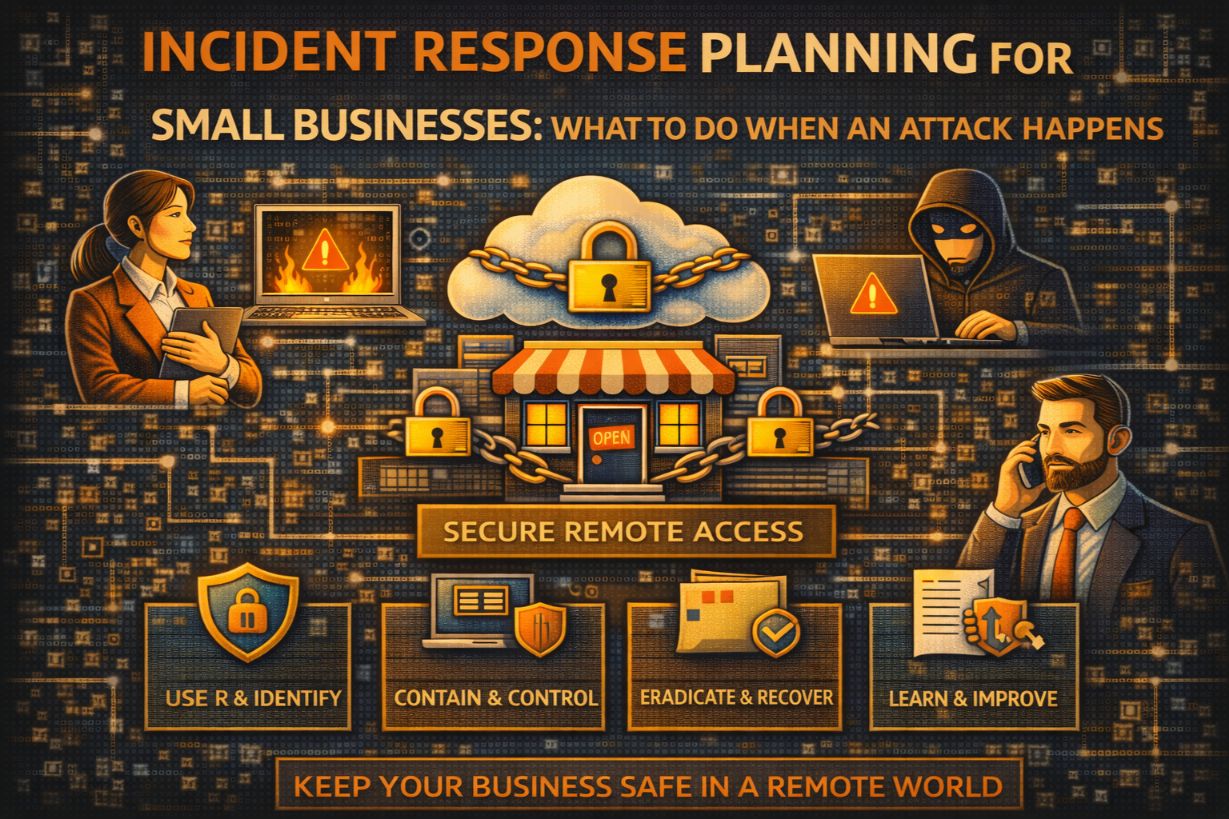
Incident Response Planning for Small Businesses: What to Do When an Attack Happens
Most small businesses assume they’ll “figure it out” if a cyber incident ever happens.
That assumption is understandable—and extremely costly.
Cyber incidents don’t fail businesses because systems are compromised. They fail businesses because decision-making collapses under pressure. Confusion, delays, and miscommunication cause more damage than the initial attack.
An incident response plan exists to prevent that collapse.
This article explains incident response planning for small businesses, what an effective plan actually includes, what to ignore, and how SMBs can prepare for incidents without creating enterprise-level bureaucracy.
Why Incident Response Matters More Than Prevention
No security program is perfect.
Eventually:
- Someone clicks
- Credentials are stolen
- A system behaves strangely
The difference between a minor incident and a business-ending event is not prevention—it’s response.
Prepared businesses:
- Detect incidents earlier
- Make decisions faster
- Contain damage
- Communicate clearly
Unprepared businesses lose time—and control.
What Incident Response Actually Means (SMB Reality)
Incident response is not:
- A technical deep dive
- A forensic investigation
- A legal proceeding
Incident response is:
“What we do in the first minutes, hours, and days after something goes wrong.”
It’s about:
- Stopping the bleeding
- Preserving options
- Avoiding irreversible mistakes
Why SMBs Struggle During Incidents
Common SMB failure patterns include:
- Not knowing who’s in charge
- Turning off systems too early
- Deleting evidence
- Calling vendors too late
- Waiting too long to escalate
These mistakes are predictable—and preventable.
What Triggers an Incident Response?
SMBs should treat any of the following as incident triggers:
- Suspicious logins
- Ransomware alerts
- Unusual data access
- Email account takeover
- Malware detections
- Vendor breach notifications
Waiting for “certainty” wastes time.
Response starts with suspicion, not proof.
The First Rule of Incident Response: Don’t Panic, Don’t Rush
Panic causes irreversible damage.
Common panic-driven mistakes:
- Rebooting infected systems
- Wiping machines
- Deleting logs
- Paying ransoms immediately
The goal is controlled containment, not emotional reaction.
The 6 Core Phases of SMB Incident Response
Incident response doesn’t need to be complex—but it must be structured.
Phase 1: Detection and Identification
Key questions:
- What happened?
- When did it start?
- What systems are affected?
This phase relies heavily on:
- Monitoring
- Logs
- User reports
Early detection reduces impact dramatically.
Phase 2: Containment (Short-Term First)
Containment aims to:
- Stop spread
- Prevent escalation
- Preserve evidence
Examples:
- Disable compromised accounts
- Isolate affected devices
- Block suspicious IPs
Do not destroy systems yet.
Phase 3: Investigation and Assessment
Once contained:
- Determine attack scope
- Identify affected data
- Understand attacker actions
This phase informs:
- Legal obligations
- Insurance claims
- Recovery strategy
Skipping this phase leads to blind recovery.
Phase 4: Eradication
Eradication removes:
- Malware
- Persistence mechanisms
- Unauthorized access
This may include:
- Rebuilding systems
- Resetting credentials
- Patching vulnerabilities
Eradication must be thorough—or attackers return.
Phase 5: Recovery
Recovery focuses on:
- Restoring systems
- Validating integrity
- Monitoring for recurrence
Backups are restored after security is verified.
Phase 6: Lessons Learned
After recovery:
- Review what failed
- Improve controls
- Update plans
Ignoring this phase guarantees repeat incidents.
What an SMB Incident Response Plan Should Actually Contain
You don’t need a binder.
You need clarity.
1. Decision Authority
Who has the authority to:
- Shut down systems?
- Engage vendors?
- Notify insurers?
- Communicate externally?
Ambiguity here causes delays.
2. Contact List (Kept Current)
Include:
- Internal leadership
- IT or MSP
- Security provider
- Cyber insurance carrier
- Legal counsel (if applicable)
During an incident, no one should be searching for phone numbers.
3. Initial Response Checklist
A short checklist prevents panic:
- Preserve logs
- Isolate affected systems
- Disable compromised accounts
- Escalate appropriately
Checklists outperform memory under stress.
4. Communication Guidelines
Define:
- Who speaks internally
- Who speaks externally
- What should not be shared
Uncontrolled communication creates legal and reputational risk.
5. Insurance and Legal Coordination
Cyber insurance policies often require:
- Immediate notification
- Approved vendors
- Specific response steps
Failing to follow these requirements can void coverage.
Why SMB Incident Response Plans Fail
Common failure reasons:
- Plans are too long
- Plans are never reviewed
- No one knows they exist
- No one is trained on them
A simple plan used consistently beats a perfect plan ignored.
The Role of Tabletop Exercises (And Why SMBs Avoid Them)
Tabletop exercises:
- Walk through a hypothetical incident
- Expose gaps safely
- Build confidence
They do not require:
- Technical expertise
- Simulations
- Consultants (though helpful)
One tabletop per year dramatically improves response.
Incident Response and Ransomware (SMB Edition)
Ransomware response mistakes include:
- Paying too early
- Restoring before eradication
- Not validating backups
- Ignoring insurance requirements
Prepared SMBs:
- Slow down decisions
- Preserve leverage
- Avoid unnecessary payments
Incident Response and Cyber Insurance
Cyber insurance often covers:
- Forensics
- Legal costs
- Notification expenses
But only if:
- You notify promptly
- You follow policy instructions
- You preserve evidence
Incident response planning protects insurance value.
Incident Response and Compliance
Regulations often require:
- Timely notification
- Evidence of due diligence
- Documented response
Improvised response weakens compliance defenses.
What SMBs Should NOT Do During an Incident
- Do not delete evidence
- Do not power off systems unless necessary
- Do not negotiate alone
- Do not communicate casually
- Do not assume it’s “contained”
Caution preserves options.
Why Speed Without Structure Is Dangerous
Fast response is good.
Unstructured response is dangerous.
Incident response plans exist to:
- Guide speed
- Prevent mistakes
- Align actions
Preparation creates calm under pressure.
How SMBs Should Build an Incident Response Plan (Realistically)
Start simple:
- Identify decision-makers
- Create a 1–2 page plan
- Document contacts
- Define first-hour actions
- Review annually
You can mature it over time.
Incident Response Is About Control
Cyber incidents remove certainty.
Incident response planning restores:
- Control
- Clarity
- Confidence
For small businesses, the plan is not about perfection.
It’s about avoiding chaos when it matters most.
Next Steps
To improve incident response readiness:
- Draft a short incident response plan
- Validate contact lists
- Review insurance requirements
- Conduct a tabletop exercise
You don’t rise to the occasion.
You fall back on preparation.