
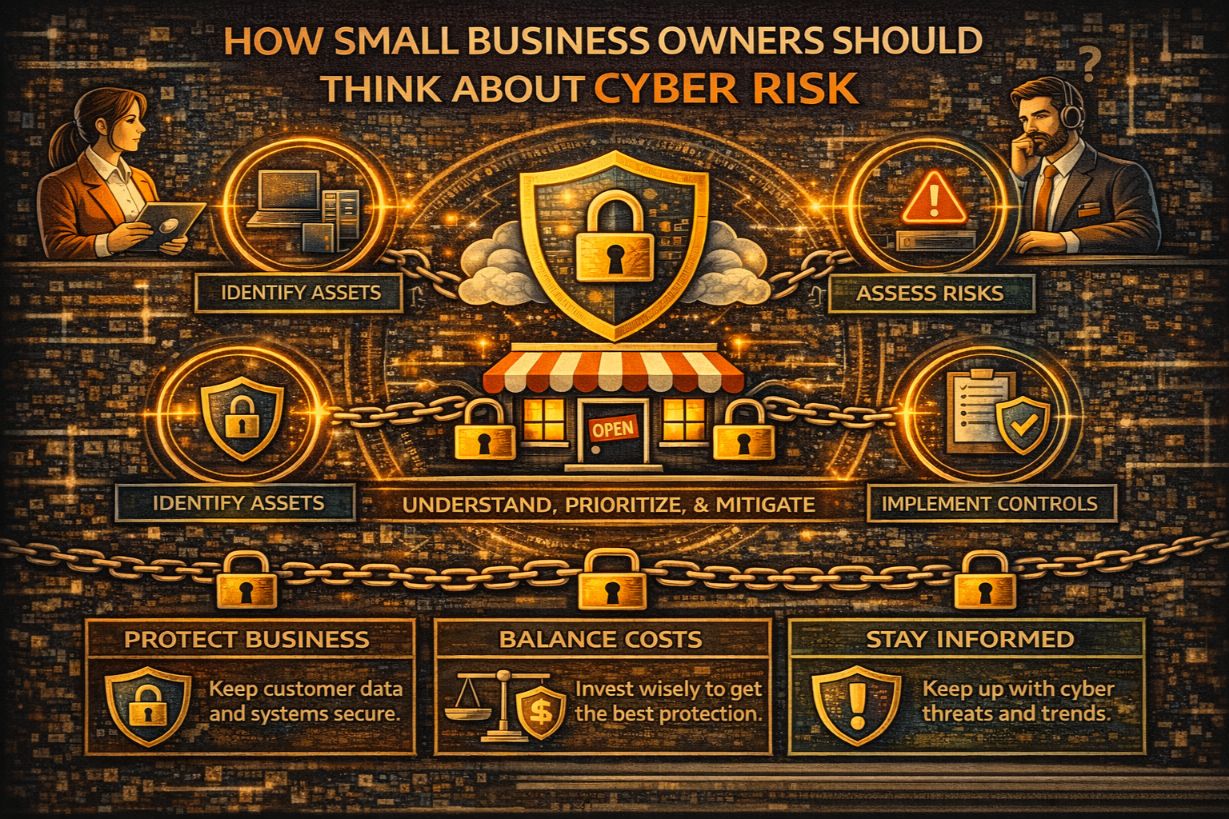
How Small Business Owners Should Think About Cyber Risk
Cybersecurity advice often misses the audience that matters most: business owners.
Owners don’t need to know:
- Which firewall is best
- How malware works
- What encryption algorithm is strongest
They need to know:
- What can actually hurt the business
- How likely that harm is
- What decisions reduce risk without killing growth
Cyber risk is not an IT problem.
It is a business survival problem.
This article explains how small business owners should think about cyber risk, how to make rational decisions under uncertainty, and how to avoid fear-driven spending and false confidence.
Why Cyber Risk Feels So Confusing to Owners
Cyber risk is uniquely frustrating because:
- Attacks are invisible until damage appears
- Experts disagree publicly
- Vendors exaggerate threats
- Consequences feel unpredictable
Unlike physical risks, cyber risk:
- Has no obvious warning signs
- Changes constantly
- Is adversarial
This creates anxiety—and bad decisions.
The First Mental Shift: Cyber Risk Is Not Binary
Most owners subconsciously think in binaries:
- “Secure or insecure”
- “Breached or safe”
Reality is probabilistic.
Cyber risk is about:
- Likelihood
- Impact
- Detection speed
- Recovery capability
You don’t eliminate cyber risk.
You manage exposure.
Think in Terms of Business Impact, Not Technical Threats
Owners should not ask:
- “Are we vulnerable to ransomware?”
They should ask:
- “What happens if we lose access to our systems for 3 days?”
- “What happens if customer data is exposed?”
- “What happens if email is compromised during payroll week?”
Impact-based thinking drives rational priorities.
The Three Cyber Outcomes That Actually Matter
For most SMBs, cyber incidents hurt in three ways:
1. Operational Disruption
Downtime stops:
- Revenue
- Customer service
- Internal operations
For many SMBs, downtime beyond a few days is existential.
2. Financial Loss
Loss comes from:
- Ransom payments
- Recovery costs
- Lost revenue
- Legal expenses
Cyber losses compound quickly.
3. Trust and Reputation Damage
Customers don’t care about:
- Root cause
- Sophistication
They care about:
- Reliability
- Transparency
- Competence
Trust is fragile.
The Owner’s Role in Cybersecurity (And What It’s Not)
Owners are not responsible for:
- Configuring systems
- Reviewing logs
- Choosing antivirus
Owners are responsible for:
- Defining risk tolerance
- Approving tradeoffs
- Assigning accountability
- Ensuring preparedness
Delegation without oversight is abdication.
Why “IT Has It Covered” Is a Dangerous Assumption
IT teams focus on:
- Keeping systems running
- Supporting users
- Managing change
They are rarely empowered to:
- Accept or reject risk
- Define downtime tolerance
- Balance cost vs exposure
Those decisions belong to leadership.
The Most Common Owner Mistakes Around Cyber Risk
Mistake #1: Overreacting to Headlines
Not every breach applies to your business.
Chasing every news story leads to:
- Tool sprawl
- Fatigue
- Inconsistent controls
Strategy beats reaction.
Mistake #2: Underreacting Because “Nothing Has Happened”
Past luck is not protection.
Most breached SMBs thought:
“We never had a problem before.”
Risk accumulates quietly.
Mistake #3: Buying Insurance Instead of Reducing Risk
Insurance helps recovery.
It does not prevent disruption.
Insurance without controls leads to:
- Denied claims
- Limited coverage
- False confidence
Mistake #4: Expecting Perfection
Perfect security is impossible.
Pursuing it wastes money and attention.
Good security is about:
- Early detection
- Containment
- Recovery
A Better Owner-Level Cyber Risk Model
Owners should frame cyber risk as:
“What is the worst plausible thing that could happen, and how do we limit the damage?”
This leads to:
- Detection investments
- Backup resilience
- Incident response planning
Not panic spending.
The 5 Questions Every SMB Owner Should Be Able to Answer
If you can’t answer these, risk is unmanaged.
- What systems can we not afford to lose?
- How long can we operate without them?
- How would we know if something was wrong?
- Who decides what to do during an incident?
- How do we recover if the worst happens?
These are leadership questions—not technical ones.
Cyber Risk and Opportunity Cost
Every dollar spent on security:
- Is not spent on growth
- Is not spent on hiring
- Is not spent on marketing
Owners must evaluate:
- Risk reduction per dollar
- Not security “completeness”
Security is about efficient risk reduction, not maximal coverage.
Why Detection and Response Matter More Than Prevention
Most owners focus on prevention because it feels comforting.
Reality:
- Prevention eventually fails
- Detection determines damage
- Response determines survival
Prepared businesses recover.
Unprepared businesses scramble.
The Owner’s Relationship With Vendors and Advisors
Owners should expect advisors to:
- Explain tradeoffs
- Quantify impact
- Admit uncertainty
Red flags include:
- Absolute guarantees
- Fear-based urgency
- One-size-fits-all solutions
Good advisors reduce anxiety—not amplify it.
Cyber Risk and Control: The Right Level of Involvement
Owners should:
- Set expectations
- Review posture periodically
- Participate in incident planning
Owners should not:
- Micromanage tools
- Approve every configuration
- Live in dashboards
Oversight, not obsession, is the goal.
How Often Owners Should Revisit Cyber Risk
At minimum:
- Annually
- After major changes
- After incidents
Cyber risk evolves as the business evolves.
The Psychological Trap: “It Won’t Happen to Us”
Most SMBs are breached by:
- Commodity attacks
- Automation
- Opportunistic criminals
You don’t need to be special to be targeted.
You just need to be reachable.
What Mature Owner Thinking Looks Like
Mature owners:
- Accept uncertainty
- Invest proportionally
- Prepare for disruption
- Avoid extremes
They don’t panic—and they don’t ignore risk.
Cybersecurity as Business Resilience, Not Fear
The healthiest framing for owners is this:
Cybersecurity is about keeping the business operating under stress.
That shifts focus from:
- Fear → preparation
- Tools → outcomes
- Blame → systems
Calm Beats Fear
Cyber risk is real.
So is vendor hype.
Owners who succeed:
- Ask better questions
- Demand clarity
- Accept tradeoffs
- Prepare intentionally
You don’t need to be fearless.
You need to be clear-eyed.
Next Steps
To take control of cyber risk as an owner:
- Request a plain-language risk briefing
- Define downtime and data-loss tolerance
- Ensure incident response planning exists
- Review insurance alignment
Cyber risk doesn’t require obsession.
It requires ownership.