
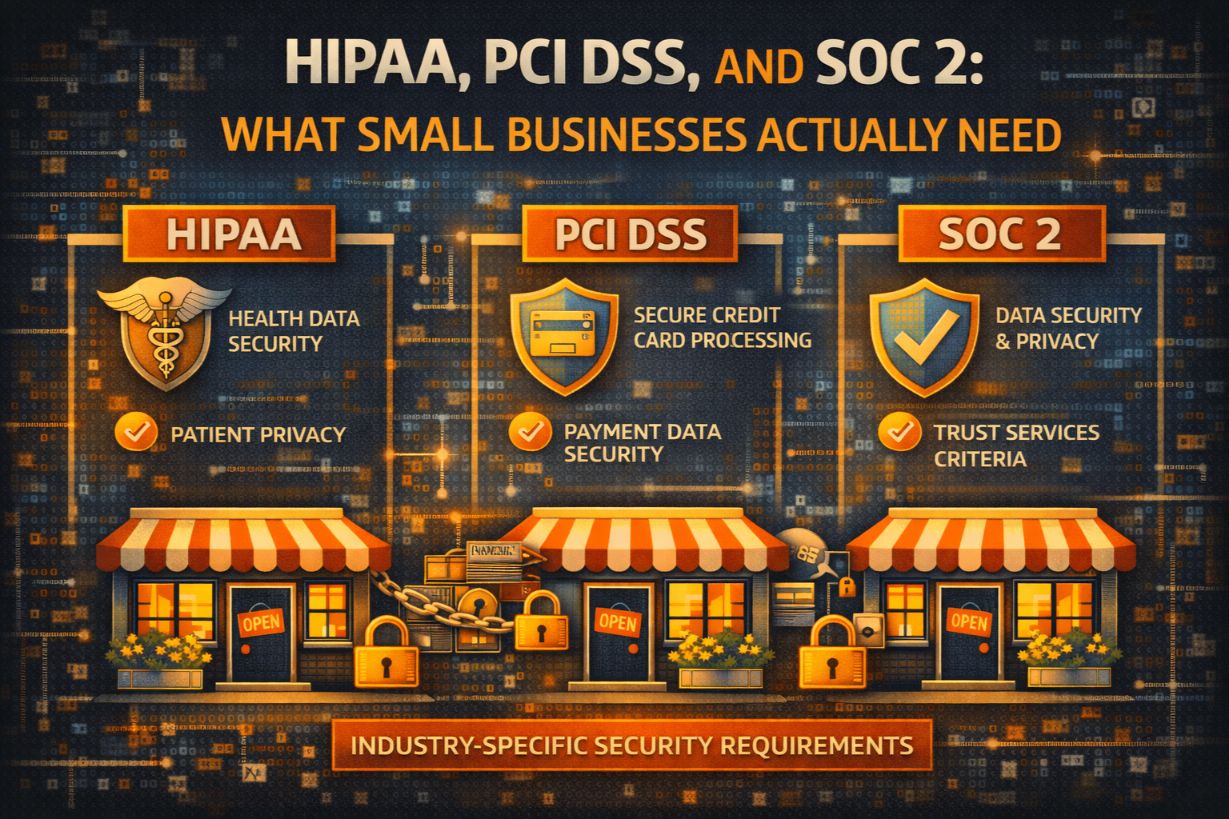
HIPAA, PCI DSS, and SOC 2: What Small Businesses Actually Need
Few things confuse small business owners more than compliance acronyms.
HIPAA.
PCI DSS.
SOC 2.
They’re often thrown around by:
- Vendors trying to sell solutions
- Customers demanding “compliance”
- Insurance providers tightening requirements
Many SMBs react in one of two ways:
- Overreaction: spending money on compliance they don’t need
- Avoidance: ignoring everything until it becomes urgent
Both are costly mistakes.
This guide explains HIPAA, PCI DSS, and SOC 2 for small businesses—what each framework is, who actually needs it, who doesn’t, and how to avoid wasting money while still protecting your business.
First: Compliance Is Triggered by Activity, Not Size
This is the most important concept to understand.
None of these frameworks apply because:
- You’re big
- You’re profitable
- You’re “important”
They apply because of:
- What data you handle
- What services you provide
- Who your customers are
If the activity applies, the regulation applies—regardless of company size.
HIPAA: When It Applies to Small Businesses
What HIPAA Is (In Simple Terms)
HIPAA governs how protected health information (PHI) is handled.
PHI includes:
- Patient names linked to medical data
- Diagnoses
- Treatment records
- Billing information tied to health services
HIPAA is enforced by the U.S. Department of Health and Human Services (HHS).
Who HIPAA Applies To
HIPAA applies to:
- Healthcare providers (even small practices)
- Health plans
- Healthcare clearinghouses
- Business associates that handle PHI
Small businesses often become subject to HIPAA without realizing it.
Examples:
- Medical billing companies
- IT providers serving healthcare
- Cloud or SaaS platforms storing PHI
- Consultants with access to patient data
If you touch PHI, HIPAA applies.
What HIPAA Requires from SMBs
HIPAA does not require enterprise-level security.
It requires:
- Risk assessments
- Administrative safeguards
- Technical safeguards
- Physical safeguards
- Policies and procedures
HIPAA is risk-based, not checklist-based.
The expectation is “reasonable safeguards” for your size and role.
Common HIPAA Myths That Hurt SMBs
- “We’re too small for HIPAA” ❌
- “Our vendor handles HIPAA for us” ❌
- “HIPAA compliance is just IT” ❌
HIPAA responsibility cannot be fully outsourced.
PCI DSS: When It Applies to Small Businesses
What PCI DSS Is
PCI DSS (Payment Card Industry Data Security Standard) applies to businesses that:
- Accept credit or debit card payments
- Store, process, or transmit cardholder data
It is enforced by:
- Card brands
- Payment processors
- Banks
PCI DSS is contractual—not governmental—but enforcement is real.
Who PCI DSS Applies To
PCI DSS applies to:
- Retailers
- E-commerce businesses
- Service providers handling card data
Size does not matter.
If you accept cards—even a few per month—PCI DSS applies.
How SMBs Reduce PCI Scope (Legitimately)
The smartest SMBs reduce exposure, not avoid compliance.
Common strategies:
- Use fully outsourced payment processors
- Avoid storing card data
- Isolate payment systems
This reduces compliance burden dramatically—but does not eliminate it entirely.
What PCI DSS Actually Requires from SMBs
At a minimum:
- Secure payment systems
- Strong access controls
- Regular vulnerability management
- Secure network configuration
- Monitoring and testing
The more card data you handle, the heavier the requirements.
Common PCI Mistakes SMBs Make
- Assuming payment processors handle everything
- Ignoring annual self-assessments
- Reusing payment terminals insecurely
- Storing card data “temporarily”
PCI penalties often appear after a breach, not before.
SOC 2: When It Applies to Small Businesses
What SOC 2 Is (And Isn’t)
SOC 2 is not a law.
It is a trust and assurance framework used primarily by:
- SaaS companies
- Technology providers
- B2B service providers
SOC 2 demonstrates that your company:
- Protects customer data
- Has defined controls
- Operates consistently
SOC 2 is customer-driven, not regulator-driven.
Who Actually Needs SOC 2
SOC 2 is typically required when:
- Selling to enterprise customers
- Handling sensitive customer data
- Competing in regulated industries
Many SMBs pursue SOC 2 prematurely.
If no customers are asking for it, SOC 2 may be optional, not required.
The Difference Between SOC 2 Type I and Type II
- Type I: Snapshot of controls at a point in time
- Type II: Evidence that controls operate effectively over months
Type II is far more demanding—and expensive.
SMBs should not pursue Type II without clear business justification.
Common SOC 2 Mistakes SMBs Make
- Treating SOC 2 as a security solution
- Pursuing it before basic security maturity
- Overengineering controls
- Underestimating ongoing effort
SOC 2 is a proof of discipline, not a starting point.
How These Frameworks Overlap (And Why That Matters)
HIPAA, PCI DSS, and SOC 2 share common themes:
- Access control
- Risk management
- Monitoring
- Incident response
- Documentation
Controls implemented correctly can support multiple frameworks.
This is how SMBs avoid duplicate spending.
The Biggest Compliance Trap for Small Businesses
The trap is chasing compliance without scoping.
Many SMBs ask:
“How do we become compliant?”
The correct question is:
“Which compliance obligations actually apply to us?”
Skipping scoping leads to:
- Overspending
- Control fatigue
- Security gaps elsewhere
How SMBs Should Decide What They Actually Need
Ask these questions:
- What data do we handle?
- Who do we handle it for?
- What contracts require security standards?
- What regulations apply based on activity?
Only then should controls be selected.
Why Vendors Oversell Compliance to SMBs
Compliance sells fear.
Vendors may:
- Push SOC 2 when it’s not required
- Overstate regulatory exposure
- Bundle unnecessary tools
SMBs must separate:
- Business requirements
from - Vendor marketing
Compliance Is a Business Decision, Not a Checkbox
HIPAA, PCI DSS, and SOC 2 are tools—not goals.
The goal is:
- Protecting customers
- Protecting revenue
- Protecting the business
Compliance should support growth, not hinder it.
Do What Applies—Not What’s Loudest
Small businesses don’t fail because they lack compliance.
They fail because they misapply it.
Understanding what actually applies:
- Reduces cost
- Improves security
- Increases credibility
- Prevents wasted effort
Do what’s required.
Do it well.
Ignore the rest.
Next Steps
To clarify your compliance obligations:
- Identify the data you handle
- Review customer and contract requirements
- Scope applicable regulations
- Align controls across frameworks
Clarity beats complexity every time.