
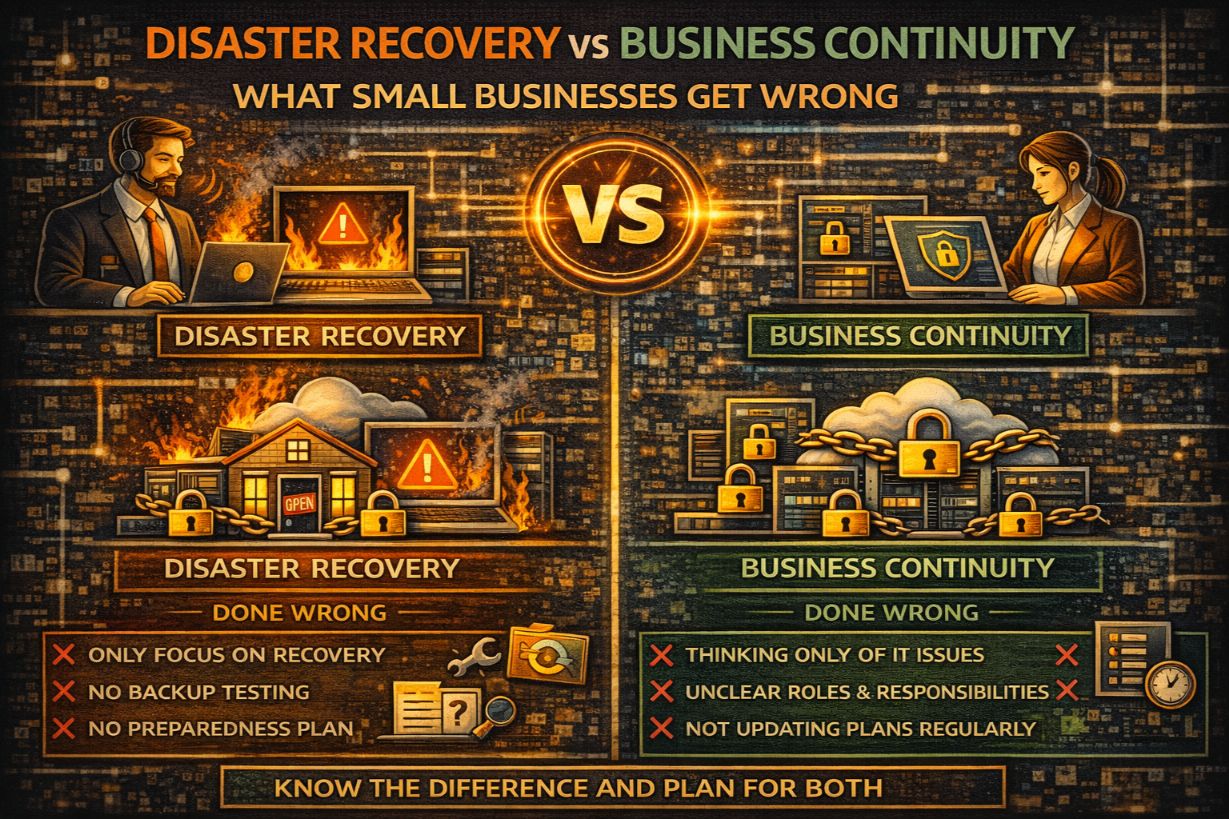
Disaster Recovery vs Business Continuity: What Small Businesses Get Wrong
Most small businesses believe they are prepared for disasters because they have backups.
That belief is comforting—and incomplete.
Backups are a tool. Recovery is a process. Continuity is a business decision.
When cyber incidents, outages, or disasters strike, many SMBs discover too late that restoring data is not the same as restoring the business. Systems come back online—but operations don’t.
This article explains the difference between disaster recovery and business continuity for small businesses, why SMBs confuse the two, and how to build realistic plans that actually keep the business running.
Why This Distinction Matters for SMB Survival
Large enterprises can absorb downtime.
Small businesses often cannot.
For SMBs:
- A few days of downtime can be fatal
- Lost customer trust compounds quickly
- Cash flow disruptions escalate fast
Understanding recovery vs continuity determines whether a business:
- Stabilizes
- Or collapses under pressure
What Disaster Recovery Actually Is
Disaster Recovery (DR) focuses on technology restoration.
Its goal:
Restore systems, data, and infrastructure after a disruptive event.
DR answers questions like:
- How do we restore servers?
- How do we recover cloud data?
- How long does it take?
Disaster recovery is IT-centric.
What Business Continuity Actually Is
Business Continuity (BC) focuses on keeping the business operating.
Its goal:
Maintain critical functions during and after disruption.
BC answers questions like:
- How do we operate without systems?
- What processes are critical?
- How do we serve customers during downtime?
Business continuity is business-centric.
Why SMBs Confuse Disaster Recovery and Business Continuity
SMBs often:
- Delegate both to IT
- Assume backups solve everything
- Ignore non-technical processes
This leads to plans that:
- Restore systems eventually
- Leave employees idle
- Leave customers uninformed
- Leave revenue stalled
Technology recovery without operational continuity is incomplete.
Disaster Recovery: What SMBs Typically Do Right (And Wrong)
What SMBs Often Do Right
- Back up data
- Use cloud storage
- Automate backups
What SMBs Often Miss
- Restore testing
- Recovery time expectations
- Dependency mapping
- Backup isolation
Backups that can’t be restored under pressure are useless.
Business Continuity: Where SMBs Struggle Most
Business continuity requires:
- Process awareness
- Cross-functional input
- Decision-making under stress
SMBs struggle because:
- Processes live in people’s heads
- Dependencies are undocumented
- Leadership involvement is limited
Continuity planning exposes uncomfortable truths about fragility.
Why Backups Alone Do Not Equal Recovery
Backups fail SMBs when:
- Restoration takes days
- Systems depend on each other
- Credentials are compromised
- Data integrity isn’t verified
Recovery is not a button.
It’s a sequence of actions.
The Key Metrics SMBs Must Understand
Two metrics matter most:
RTO (Recovery Time Objective)
How long can a system be down before damage is unacceptable?
For SMBs, RTO is a business decision, not an IT one.
RPO (Recovery Point Objective)
How much data loss is acceptable?
One hour?
One day?
Zero?
If you don’t define RPO, you accept unlimited data loss by default.
Why SMBs Underestimate Downtime Impact
Downtime impacts more than IT:
- Payroll delays
- Billing failures
- Customer churn
- Regulatory issues
Many SMBs calculate downtime cost incorrectly—or not at all.
What a Realistic Disaster Recovery Plan Includes
A useful DR plan includes:
- System inventory
- Backup locations
- Restoration order
- Access credentials
- Validation steps
It focuses on how recovery happens—not just where backups exist.
What a Realistic Business Continuity Plan Includes
A practical BC plan includes:
- Critical business functions
- Manual workarounds
- Communication plans
- Vendor dependencies
- Decision authority
BC plans prioritize people and processes over technology.
Example: Ransomware Incident Without Continuity Planning
Scenario:
- Ransomware encrypts systems
- Backups exist
- Restore takes 3 days
Without BC:
- Employees can’t work
- Customers receive no updates
- Revenue halts
With BC:
- Manual processes kick in
- Communication is controlled
- Core services continue
The difference is planning—not tools.
Disaster Recovery vs Business Continuity: Side-by-Side
| Area | Disaster Recovery | Business Continuity |
| Focus | Technology | Operations |
| Owner | IT | Leadership |
| Goal | Restore systems | Keep business running |
| Timeline | After incident | During and after |
| Success | Systems online | Revenue preserved |
Both are required.
Why SMBs Avoid Continuity Planning
Common reasons:
- Feels abstract
- Requires leadership time
- Exposes weaknesses
- Not immediately billable
But continuity planning pays off only during crises—which is when it matters most.
How Cyber Incidents Changed the DR/BC Equation
Cyber incidents:
- Affect multiple systems simultaneously
- Corrupt backups
- Target recovery mechanisms
- Extend downtime unpredictably
Traditional DR assumptions no longer hold.
Cloud and Continuity: False Confidence
Cloud services improve resilience—but don’t guarantee continuity.
Cloud outages, account lockouts, and misconfigurations still disrupt operations.
Continuity planning remains necessary.
How SMBs Should Approach DR and BC Together
A practical approach:
- Identify critical business functions
- Map systems supporting those functions
- Define acceptable downtime
- Validate backups against those timelines
- Plan manual workarounds
This aligns IT recovery with business survival.
Testing: The Step SMBs Skip (And Regret)
Plans that aren’t tested:
- Drift
- Become outdated
- Fail under pressure
Even simple tests:
- Backup restores
- Tabletop exercises
Reveal critical gaps early.
DR, BC, and Cyber Insurance
Insurers increasingly ask:
- How quickly can you recover?
- Do you have continuity plans?
- Have backups been tested?
Preparedness affects:
- Coverage
- Claims
- Premiums
Common SMB Mistakes to Avoid
- Assuming backups equal recovery
- Leaving continuity to IT
- Not defining RTO/RPO
- Not testing plans
- Ignoring vendor dependencies
These mistakes compound during incidents.
The Strategic Truth for SMBs
Disaster recovery restores systems.
Business continuity preserves the business.
You need both.
Without continuity:
- Recovery is slow and chaotic
Without recovery:
- Continuity is temporary
Together, they provide resilience.
Survival Requires More Than Data
Data can be restored.
Trust is harder.
Revenue is fragile.
For small businesses, resilience is not about perfection.
It’s about knowing how to operate when things break.
Next Steps
To improve resilience:
- Identify critical business functions
- Define acceptable downtime
- Test backups realistically
- Build simple continuity playbooks
Disasters don’t ask if you’re ready.
They reveal whether you were.