
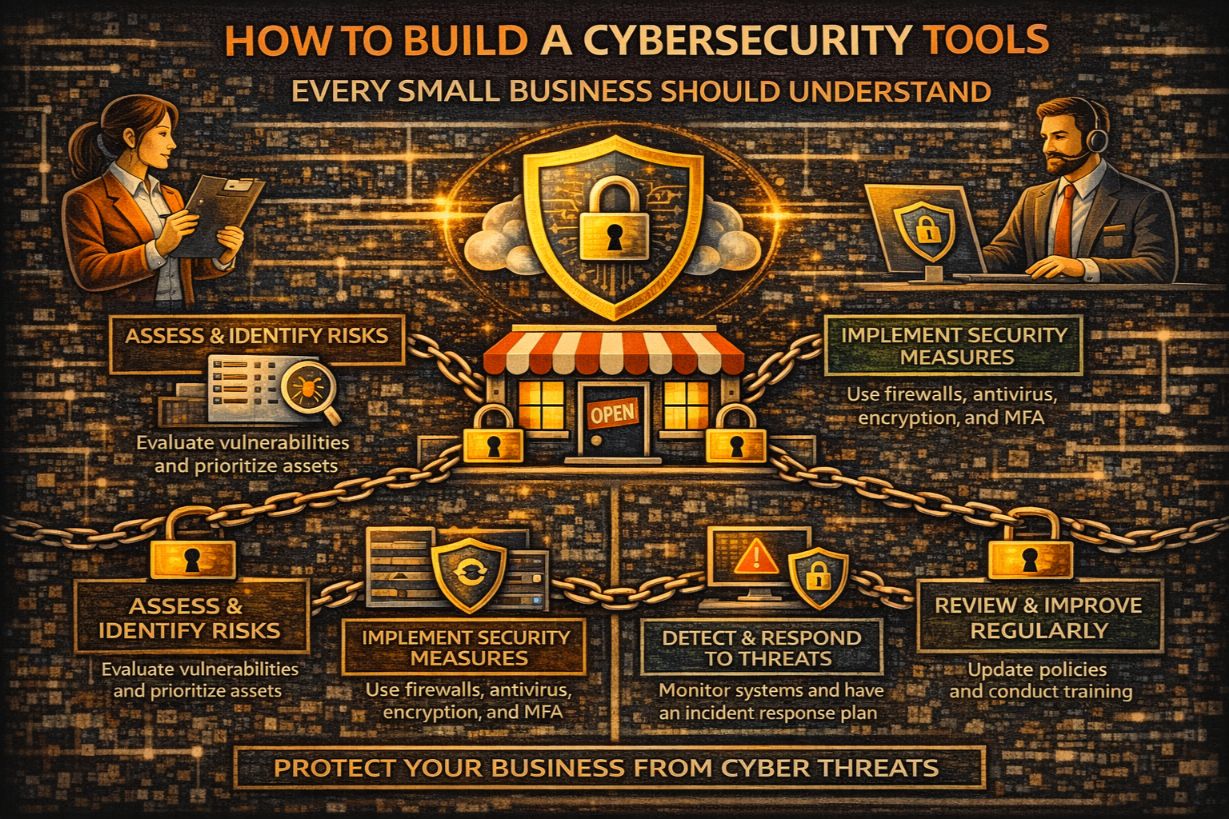
How to Build a Cybersecurity Strategy for Small Businesses
Most small businesses don’t lack cybersecurity tools.
They lack a cybersecurity strategy.
Without strategy, security becomes reactive:
- Buy tools after incidents
- Respond to fear instead of risk
- Overspend in some areas and underinvest in others
A cybersecurity strategy exists to prevent that chaos. It aligns security decisions with business priorities, resource constraints, and real-world threats.
This article explains how to build a cybersecurity strategy for small businesses, what leadership must own, what IT should execute, and how to avoid turning security into a never-ending cost center.
Why SMBs Need Strategy More Than Enterprises
Large enterprises can survive inefficiency.
SMBs cannot.
For SMBs:
- Budgets are tight
- Staff is limited
- Downtime is existential
A strategy ensures:
- Every dollar reduces meaningful risk
- Security decisions are defensible
- Tradeoffs are intentional—not accidental
Security without strategy is guesswork.
Cybersecurity Strategy Is Not a Tool List
A strategy is not:
- A stack of products
- A compliance checklist
- A vendor roadmap
A strategy is:
A set of prioritized decisions about how the business will manage cyber risk over time.
Tools support strategy—not the other way around.
Step 1: Define What You’re Actually Protecting
You cannot protect everything equally.
Leadership must answer:
- What systems generate revenue?
- What data would cause the most damage if lost or exposed?
- What downtime would be catastrophic?
This creates risk-based prioritization.
Most SMBs skip this step—and overspend randomly.
Step 2: Understand Your Real Threats
Not all threats matter equally.
SMB-relevant threats usually include:
- Phishing and credential theft
- Ransomware
- Business email compromise
- Cloud account takeover
- Vendor-related breaches
Rarely:
- Nation-state attacks
- Zero-day exploits
Strategy focuses on likely, high-impact threats.
Step 3: Establish Your Risk Tolerance
Every business accepts some risk.
Leadership must decide:
- How much downtime is acceptable?
- How much data loss is tolerable?
- What compliance exposure exists?
Undefined risk tolerance leads to:
- Overreaction
- Underinvestment
- Conflicting decisions
Strategy requires explicit tolerance.
Step 4: Choose a Guiding Framework (Lightly)
Frameworks provide structure—not rigidity.
For SMBs:
- NIST CSF = strategic alignment
- CIS Controls = tactical execution
Use frameworks to:
- Organize thinking
- Communicate priorities
- Justify decisions
Do not turn them into bureaucracy.
Step 5: Define Security Ownership and Governance
Security fails when ownership is unclear.
Leadership must define:
- Who owns cyber risk? (Hint: not just IT)
- Who makes decisions during incidents?
- Who approves spending and tradeoffs?
Cybersecurity is a business risk, not an IT hobby.
Step 6: Build a Realistic Security Roadmap
A strategy becomes real through sequencing.
A practical SMB roadmap:
- Identity security (MFA, access control)
- Email protection
- Endpoint protection
- Backups and recovery
- Monitoring and response
Each phase should:
- Reduce measurable risk
- Fit operational capacity
- Be reviewed regularly
Step 7: Align Security With Budget Reality
Security strategy must respect constraints.
That means:
- Choosing managed services over staffing when needed
- Prioritizing controls with highest ROI
- Avoiding “best-in-class” for everything
Perfect security is impossible.
Sustainable security is strategic.
Step 8: Integrate Cyber Insurance Intentionally
Insurance is part of strategy—not a fallback.
Strategy should ensure:
- Controls match insurance representations
- Incident response aligns with policy requirements
- Coverage gaps are understood
Insurance supports strategy—it doesn’t replace it.
Step 9: Prepare for Incidents (Before They Happen)
Strategy assumes failure will occur.
Prepared SMBs:
- Have incident response plans
- Know decision authority
- Practice response
Unprepared SMBs improvise under pressure—and regret it.
Step 10: Measure What Matters (Not Vanity Metrics)
Good metrics answer:
- Are we reducing risk?
- Are we detecting faster?
- Are incidents smaller?
Bad metrics include:
- Number of tools
- Number of alerts
- Compliance checkboxes
Strategy demands outcome-based metrics.
Why Leadership Must Be Involved
Cybersecurity decisions involve:
- Financial tradeoffs
- Operational disruption
- Legal exposure
- Reputational risk
These are leadership decisions.
When security is delegated entirely to IT:
- Risk tolerance is undefined
- Spending is misaligned
- Accountability is weak
Leadership involvement doesn’t mean micromanagement—it means ownership.
Common SMB Strategy Mistakes
- Chasing every new threat
- Buying tools without roadmap
- Ignoring incident response
- Treating compliance as strategy
- Expecting perfection
Strategy fails when it’s reactive.
Strategy vs. Tactics: Why Both Matter
Strategy answers:
- “What risks matter most?”
Tactics answer:
- “What controls do we deploy?”
SMBs often jump straight to tactics—and miss the bigger picture.
How Strategy Changes Security Conversations
With strategy:
- Security spend is justified
- Tradeoffs are explained
- Vendors are evaluated rationally
- Incidents are managed calmly
Without strategy:
- Decisions are emotional
- Spending is inconsistent
- Leadership is surprised
The Long-Term View: Cybersecurity as Business Resilience
Cybersecurity strategy is not about stopping attacks.
It’s about:
- Surviving incidents
- Preserving trust
- Maintaining operations
- Protecting optionality
For SMBs, resilience beats perfection.
What “Good” SMB Cybersecurity Strategy Looks Like
- Clear priorities
- Limited but effective controls
- Defined ownership
- Realistic budget alignment
- Continuous improvement
It evolves—but doesn’t thrash.
Strategy Turns Fear Into Control
Cyber threats create uncertainty.
Strategy creates:
- Clarity
- Discipline
- Confidence
Small businesses don’t need enterprise security.
They need intentional security.
That starts with strategy.
Next Steps
To build or refine your cybersecurity strategy:
- Identify critical business assets
- Define risk tolerance
- Align controls with priorities
- Assign ownership
- Review annually
Cybersecurity maturity is not about tools.
It’s about decisions.