
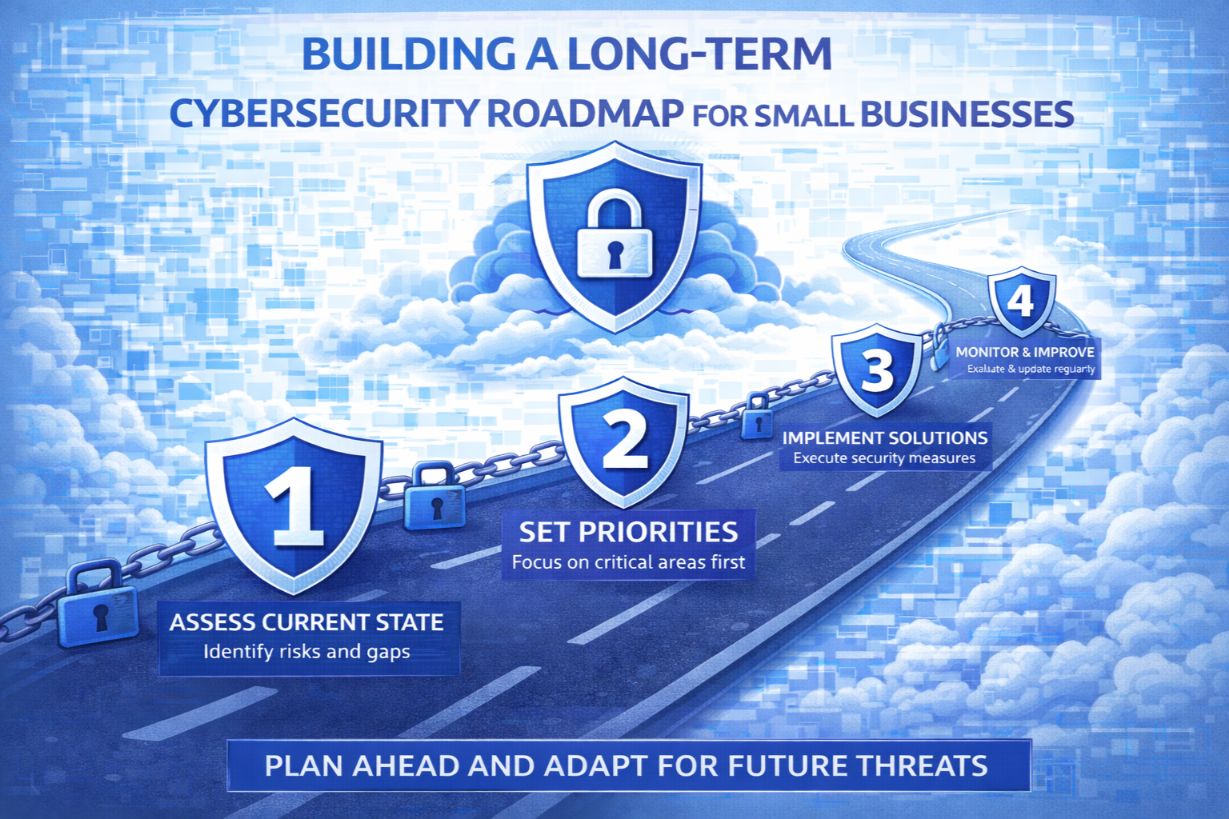
Building a Long-Term Cybersecurity Roadmap for Small Businesses
Most small businesses don’t fail at cybersecurity because they did nothing.
They fail because they did things in the wrong order, reacted to incidents instead of planning, and reset priorities every year without building momentum.
A cybersecurity roadmap solves that problem.
A roadmap is not a wish list.
It’s not a vendor pitch deck.
It’s not a compliance checklist.
A roadmap is a sequenced plan for reducing cyber risk over time—aligned with business growth, budget reality, and operational capacity.
This article explains how small businesses can build a long-term cybersecurity roadmap, why roadmaps fail, and how to make security maturity cumulative instead of cyclical.
Why SMBs Need a Roadmap (Not Just Strategy)
A strategy defines direction.
A roadmap defines execution over time.
Without a roadmap:
- Security resets every budget cycle
- Tools are added without integration
- Gaps reappear after staff changes
- Lessons from incidents are forgotten
Roadmaps create continuity, even when people and priorities change.
The Biggest Roadmap Mistake SMBs Make
Trying to do everything at once.
This leads to:
- Overwhelm
- Partial implementations
- Burnout
- Abandoned controls
A good roadmap accepts:
- Limited capacity
- Limited budget
- Incremental improvement
Progress beats intensity.
What a Cybersecurity Roadmap Actually Is
A practical SMB roadmap includes:
- A current-state baseline
- A target maturity level
- Sequenced initiatives
- Ownership assignments
- Review checkpoints
It spans multiple years, not months.
Step 1: Establish a Realistic Baseline
You can’t plan forward without knowing where you are.
Baseline assessment should answer:
- What controls exist today?
- What’s working?
- What’s missing or inconsistent?
- Where are the biggest risks?
This does not require:
- Enterprise audits
- Excessive documentation
It requires honesty.
Step 2: Define the Target State (Not Perfection)
Your target state is not “fully secure.”
It’s:
“Secure enough to support the business we plan to be.”
Target state depends on:
- Growth plans
- Industry risk
- Regulatory exposure
- Technology dependency
Most SMBs aim for mature basics, not advanced security.
Step 3: Choose a Simple Maturity Model
Roadmaps work best when anchored to a structure.
For SMBs:
- NIST CSF → organizing framework
- CIS Controls IG1 → execution baseline
You don’t need:
- Custom frameworks
- Complex scoring
You need consistency.
Step 4: Sequence Initiatives by Risk Reduction
Roadmaps should prioritize:
- Controls that reduce common attack paths
- Capabilities that limit blast radius
- Improvements that support detection and recovery
Typical high-priority sequencing:
- Identity security (MFA, access control)
- Email security
- Endpoint protection
- Backups and recovery
- Monitoring and response
Later phases build depth—not basics.
Step 5: Align Roadmap With Business Milestones
Security maturity should evolve with:
- Hiring growth
- New locations
- Cloud migrations
- New regulations
- Mergers or acquisitions
Roadmaps that ignore business change become obsolete quickly.
Step 6: Assign Clear Ownership for Each Phase
Every roadmap initiative needs:
- An owner
- A success definition
- A maintenance plan
Unowned controls decay.
Ownership doesn’t always mean execution—it means accountability.
Step 7: Budget in Phases, Not All at Once
Roadmaps prevent budget shock.
Instead of:
- Large, sudden spends
You plan:
- Predictable, phased investment
This:
- Improves cash flow planning
- Reduces decision fatigue
- Improves ROI
Security becomes a managed operating cost, not a surprise.
Example: A 3-Year SMB Cybersecurity Roadmap (Simplified)
Year 1: Stabilize the Basics
Focus:
- MFA everywhere
- Admin access cleanup
- Email security
- Backup isolation
- Incident response planning
Goal:
- Stop common attacks
- Enable basic recovery
Year 2: Improve Visibility and Response
Focus:
- 24/7 monitoring
- EDR maturity
- Cloud activity monitoring
- Tabletop exercises
Goal:
- Detect incidents early
- Reduce dwell time
Year 3: Optimize and Scale
Focus:
- Zero Trust refinements
- Vendor risk management
- Advanced recovery testing
- Compliance alignment
Goal:
- Support growth
- Improve resilience
Why Roadmaps Fail in SMBs
Common failure reasons:
- No executive sponsorship
- Overambitious timelines
- Tool-driven planning
- No review cadence
- No adjustment for change
Roadmaps must be living documents, not static plans.
The Importance of Review and Reprioritization
At least annually, roadmaps should be reviewed for:
- New threats
- Business changes
- Incident lessons
- Budget adjustments
Security that doesn’t adapt becomes fragile.
Roadmaps and Incident Learning
Every incident—large or small—should:
- Update the roadmap
- Adjust priorities
- Improve controls
Incidents are feedback—not just failures.
Roadmaps vs Compliance Checklists
Compliance asks:
- “Are we meeting minimum requirements?”
Roadmaps ask:
- “Are we getting meaningfully safer over time?”
Compliance can support roadmaps.
It should not replace them.
Roadmaps Reduce Vendor Influence
With a roadmap:
- Vendors fit into your plan
- Purchases are intentional
- Sales urgency loses power
Without a roadmap:
- Vendors define priorities
Control shifts to leadership.
Roadmaps Improve Insurance and Audit Outcomes
Insurers and auditors respond well to:
- Documented improvement plans
- Demonstrated progress
- Clear ownership
Roadmaps show due diligence—even mid-journey.
The Psychological Benefit of a Roadmap
Roadmaps reduce:
- Anxiety
- Reactive decisions
- “Are we doing enough?” questions
They replace fear with direction.
What a Good SMB Roadmap Is Not
- Not rigid
- Not exhaustive
- Not vendor-specific
- Not a guarantee
It’s a guide—not a promise.
Maturity Is Built, Not Bought
Cybersecurity maturity doesn’t come from:
- One big purchase
- One compliance effort
- One consultant engagement
It comes from:
- Consistent execution
- Incremental improvement
- Leadership alignment
A roadmap turns good intentions into durable progress.
Next Steps
To build a long-term cybersecurity roadmap:
- Perform a baseline assessment
- Define a realistic target state
- Sequence controls by risk reduction
- Align with business growth
- Review annually
Security maturity isn’t about speed.
It’s about direction—and staying on course