
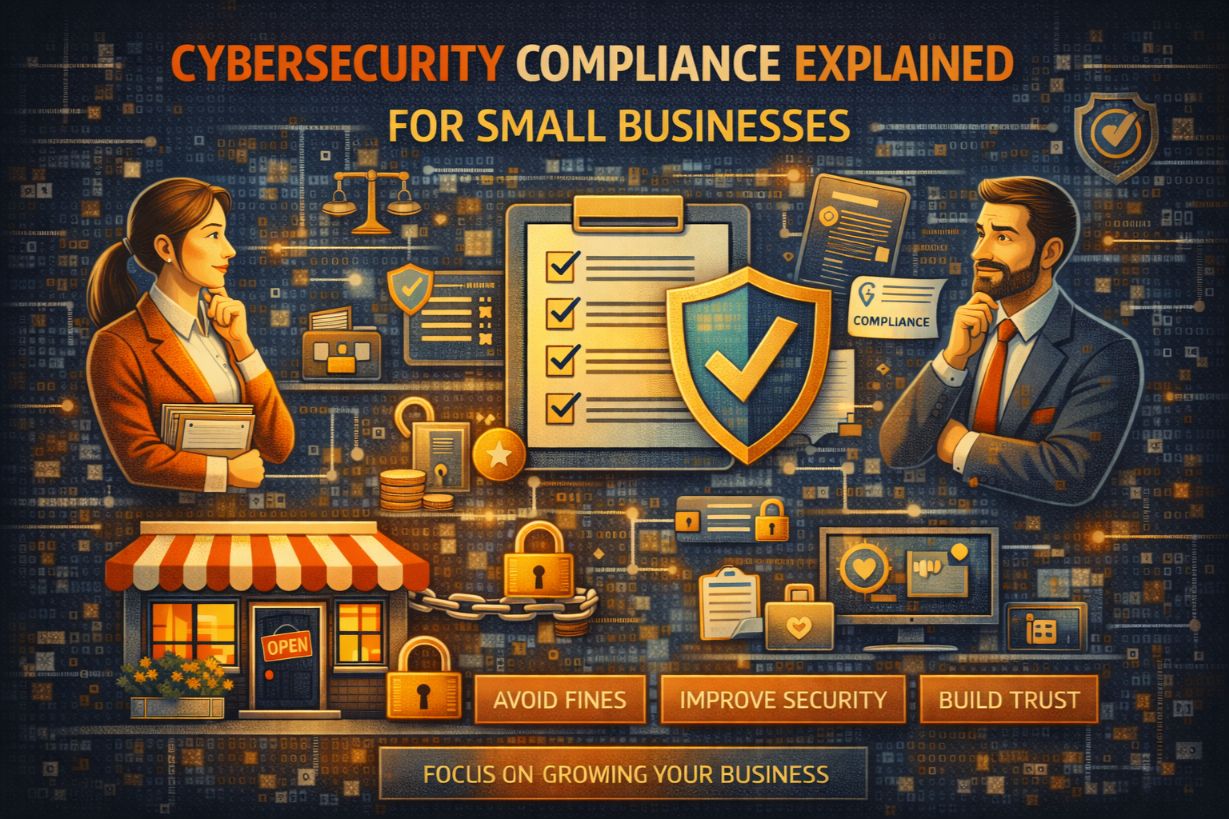
Cybersecurity Compliance Explained for Small Businesses
Cybersecurity compliance is one of the most misunderstood—and most feared—topics for small businesses.
Many SMB owners believe compliance means:
- Endless paperwork
- Enterprise-level security budgets
- Audits designed to punish them
- Rules that only apply to large corporations
That belief leads to one of two dangerous outcomes:
- Overreaction – spending money on controls you don’t need
- Avoidance – ignoring compliance entirely until something goes wrong
The truth is simpler—and more dangerous if misunderstood.
This guide explains cybersecurity compliance for small businesses in practical terms: what compliance actually means, which regulations matter, what doesn’t apply, and how SMBs can meet requirements without crippling operations.
What Cybersecurity Compliance Really Means
Compliance is not about being “perfectly secure.”
Compliance means:
- You have reasonable safeguards in place
- You follow documented processes
- You meet specific legal or contractual requirements
- You can demonstrate due diligence
Compliance is about defensibility, not invulnerability.
When something goes wrong, regulators and courts don’t ask:
“Were you hacked?”
They ask:
“Did you act reasonably for your size, industry, and risk?”
Why Cybersecurity Compliance Matters to SMBs
Small businesses often assume regulators ignore them.
They don’t.
Compliance matters because:
- SMBs handle regulated data
- SMBs are vendors to regulated companies
- SMBs are subject to state and federal laws
- SMBs face contractual security requirements
Non-compliance can result in:
- Fines and penalties
- Lawsuits
- Contract termination
- Insurance denial
- Loss of customers
Compliance failures often surface after a breach—when consequences are highest.
The Biggest Compliance Myth SMBs Believe
“Compliance only applies if we’re big enough.”
False.
Most regulations apply based on:
- Data type, not company size
- Business activity, not revenue
- Customer location, not headquarters
If you handle certain data, compliance applies—regardless of size.
The Three Main Sources of Compliance Requirements
SMBs typically face compliance obligations from three places:
1. Laws and Regulations
These are enforced by governments.
Examples include:
- State data privacy laws
- Federal regulations
- Industry-specific mandates
Violations can result in fines or legal action.
2. Industry Standards
These may not be laws, but they are enforced contractually.
Examples include:
- PCI DSS (payment cards)
- HIPAA (healthcare)
- SOC 2 (trust and assurance)
Failure can mean loss of ability to operate or accept payments.
3. Contracts and Customer Requirements
Many SMBs are required to meet security standards because:
- Customers demand it
- Partners require it
- Insurance policies mandate it
Contractual compliance is often more immediate than regulatory enforcement.
Common Regulations That Affect Small Businesses
Not all regulations apply to all SMBs—but many apply more often than owners realize.
State Data Privacy Laws
Many states now require businesses to:
- Protect personal data
- Notify individuals after breaches
- Maintain reasonable security controls
These laws apply regardless of business size.
HIPAA (Healthcare)
If you handle protected health information (PHI):
- Medical practices
- Billing companies
- IT providers to healthcare
HIPAA compliance is mandatory—even for very small businesses.
PCI DSS (Payment Cards)
If you process credit card payments:
- Online
- In-person
- Through third parties
You must meet PCI DSS requirements.
Outsourcing payment processing reduces scope—but does not eliminate responsibility.
FTC Safeguards Rule
This applies to many SMBs that handle:
- Financial information
- Customer records
- Consumer data
It requires documented security programs—not just tools.
Compliance vs. Security: The Critical Difference
Compliance does not equal security.
You can be:
- Compliant but insecure
- Secure but non-compliant
The goal is alignment, not checkbox completion.
Compliance defines minimum expectations.
Security addresses real-world threats.
SMBs that focus only on compliance often miss actual risks.
What Regulators Expect from Small Businesses
Regulators do not expect SMBs to operate like enterprises.
They expect:
- Risk awareness
- Reasonable safeguards
- Documented processes
- Continuous improvement
The phrase “reasonable security” is intentionally flexible.
Your controls should match:
- Your size
- Your industry
- Your risk exposure
The Core Compliance Expectations for Most SMBs
While requirements vary, most compliance frameworks expect these basics:
1. Risk Assessment
You must understand:
- What data you handle
- What risks exist
- Where controls are needed
No risk assessment = no defensibility.
2. Access Controls
You should be able to show:
- Who has access
- Why they have it
- How access is removed
Shared accounts are a compliance red flag.
3. Data Protection Measures
This includes:
- Encryption where appropriate
- Secure storage
- Backup protection
Data protection is a core compliance theme.
4. Incident Response Capability
You don’t need a war room—but you need a plan.
Regulators expect:
- Defined response steps
- Notification awareness
- Responsibility assignment
“No plan” is not acceptable.
5. Security Awareness Training
Human error is acknowledged—but training is expected.
Most frameworks require:
- Basic training
- Ongoing reinforcement
- Documented participation
Why Documentation Matters More Than Tools
This surprises many SMBs.
From a compliance perspective:
- A control you can’t document might as well not exist
- An action you can’t prove didn’t happen
Documentation demonstrates intent and effort.
You don’t need excessive paperwork—but you need:
- Policies
- Procedures
- Evidence
Common SMB Compliance Mistakes
- Assuming vendors handle compliance entirely
- Buying tools without policies
- Ignoring documentation
- Treating compliance as a one-time project
- Overengineering controls
- Avoiding compliance until forced
These mistakes increase risk and cost.
Compliance After a Breach: The Worst Time to Learn
Most compliance enforcement happens after incidents.
Post-breach, regulators examine:
- What you knew
- What you did
- What you failed to do
If controls were missing or undocumented, penalties increase.
Preparation changes outcomes.
How SMBs Should Approach Compliance Strategically
Smart SMBs treat compliance as:
- A risk management exercise
- A customer trust enabler
- A competitive advantage
Instead of asking:
“What’s the minimum we can do?”
Ask:
“What’s reasonable for our risk?”
That mindset leads to better decisions.
Compliance Is Not Optional—But It Is Manageable
Cybersecurity compliance doesn’t require:
- Enterprise budgets
- Massive teams
- Endless audits
It requires:
- Understanding obligations
- Prioritizing risks
- Implementing baseline controls
- Documenting decisions
That’s achievable for SMBs.
Compliance Is About Defensibility
Compliance exists to answer one question:
“Did you act responsibly with the data you were trusted with?”
For small businesses, that answer determines:
- Legal exposure
- Financial impact
- Customer trust
- Long-term viability
Ignoring compliance doesn’t eliminate responsibility—it just removes your defense.
Next Steps
To understand your compliance exposure:
- Identify the data you handle
- Review applicable regulations
- Conduct a risk assessment
- Document existing controls
Clarity today prevents enforcement tomorrow.