
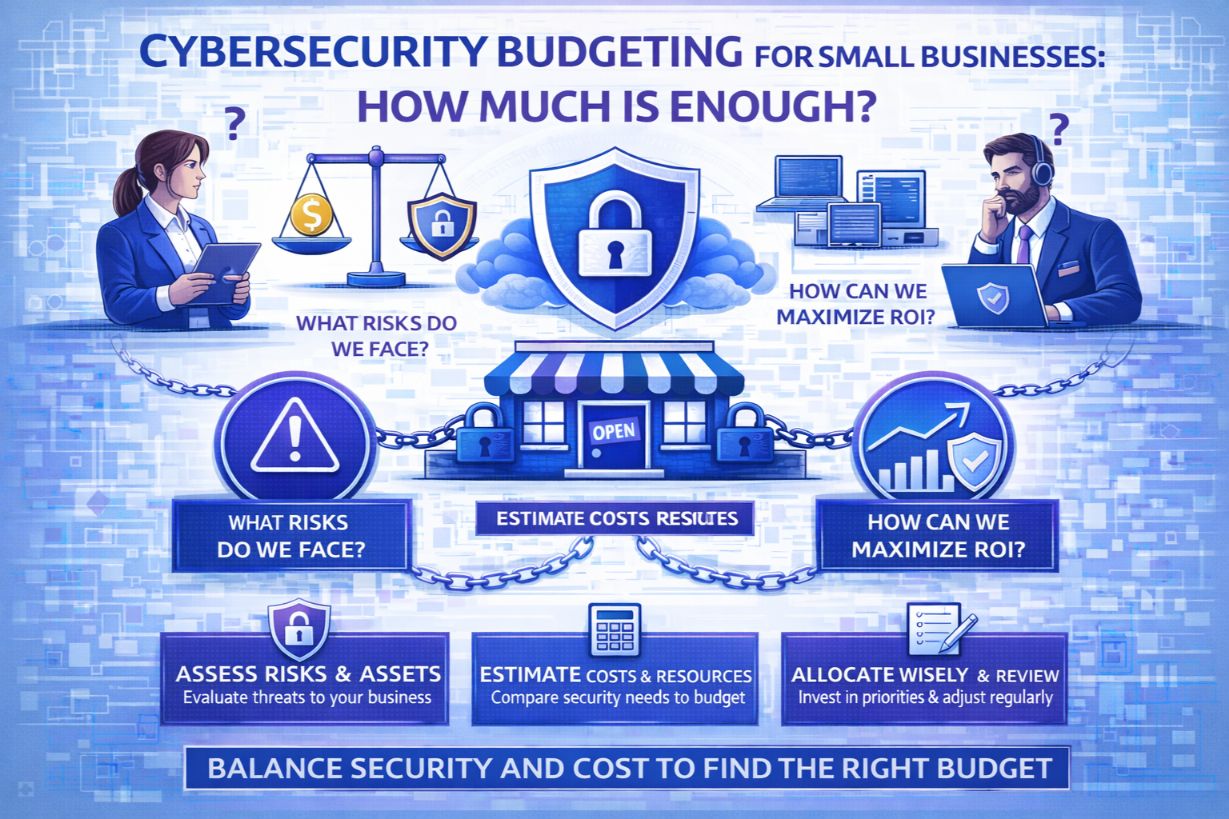
Cybersecurity Budgeting for Small Businesses: How Much Is Enough?
“How much should we spend on cybersecurity?”
It’s one of the most common questions small business owners ask—and one of the hardest to answer honestly.
Search online and you’ll see:
- “Spend 10% of IT budget on security”
- “Spend 5% of revenue”
- “Buy best-in-class tools”
None of those answers are useful without context.
Cybersecurity budgeting is not about hitting an industry average. It’s about spending enough to avoid unacceptable outcomes—without starving the business of growth capital.
This article explains how small businesses should think about cybersecurity budgeting, what actually drives cost, how to avoid under- and over-spending, and how to align security investment with real business risk.
Why SMB Cybersecurity Budgeting Feels Impossible
Cybersecurity budgeting is hard because:
- Losses are probabilistic, not guaranteed
- Attacks are unpredictable in timing
- ROI is mostly “avoided pain”
- Vendors frame everything as critical
Unlike marketing or sales, security doesn’t generate revenue.
It protects revenue that already exists.
That makes it psychologically uncomfortable to fund.
The First Budgeting Rule: Stop Using Percentages Blindly
Rules like:
- “10% of IT budget”
- “5–15% of revenue”
Are starting points, not decisions.
They fail because:
- Two SMBs with identical revenue can have wildly different risk
- Data sensitivity varies
- Downtime tolerance varies
- Regulatory exposure varies
Budgeting must be risk-adjusted, not formulaic.
Cybersecurity Spending Is About Avoiding Business Failure Modes
A better question than “How much should we spend?” is:
“What failure scenarios can we not afford?”
Examples:
- 3 days of downtime during peak season
- Payroll disruption
- Customer data exposure
- Inability to operate for a week
Your budget should aim to reduce the likelihood and impact of those scenarios.
The 4 Drivers That Should Determine Your Cybersecurity Budget
1. Revenue Dependency on Technology
Ask:
- Can we operate without systems?
- For how long?
Businesses that are:
- Cloud-native
- Transaction-driven
- Remote-first
Have higher dependency, and therefore higher justified spend.
2. Data Sensitivity
Do you handle:
- Customer PII?
- Financial data?
- Health data?
- Proprietary IP?
Higher data sensitivity = higher breach impact = higher justified investment.
3. Downtime Tolerance
Downtime tolerance is a leadership decision.
If:
- 1–2 days of downtime is survivable → lower spend acceptable
- 1–2 days of downtime is catastrophic → resilience spend is mandatory
Downtime tolerance directly drives:
- Backup investment
- Monitoring investment
- Incident response readiness
4. Regulatory and Insurance Pressure
If you face:
- HIPAA
- FTC Safeguards Rule
- State privacy laws
- Cyber insurance underwriting scrutiny
You will spend more—whether proactively or reactively.
The SMB Cybersecurity Spending Curve (Reality Check)
SMB security spend typically falls into three zones:
Under-Spending (Most Common)
Characteristics:
- Minimal tools
- No monitoring
- No response planning
- Heavy reliance on luck
Outcomes:
- Lower monthly costs
- Higher breach probability
- Catastrophic downside risk
Strategic Spending (Ideal)
Characteristics:
- Focused controls
- Managed detection/response
- Tested backups
- Clear ownership
Outcomes:
- Predictable spend
- Reduced impact
- High survivability
Over-Spending (Also Common)
Characteristics:
- Tool sprawl
- Underused features
- No monitoring ownership
- Security fatigue
Outcomes:
- High cost
- No proportional risk reduction
- False confidence
The goal is the middle zone.
What SMBs Should Expect to Spend (Reality Ranges)
While exact numbers vary, realistic SMB cybersecurity budgets often fall into ranges like:
- Low-risk SMBs: 3–6% of IT spend
- Moderate-risk SMBs: 6–10% of IT spend
- High-dependency or regulated SMBs: 10–15%+ of IT spend
But again—risk matters more than percentages.
Why Managed Services Often Win on Budget Efficiency
Hiring internally is expensive.
A single qualified security analyst often costs:
- $90k–$130k+ fully loaded
And still doesn’t provide:
- 24/7 coverage
- Backup staff
- Broad expertise
Managed security:
- Converts fixed labor costs into shared services
- Improves coverage per dollar
- Aligns cost with risk
For most SMBs, managed services deliver higher security ROI.
The Most Common SMB Budgeting Mistakes
Mistake #1: Spending Only After Incidents
Reactive spending:
- Is rushed
- Is emotional
- Is inefficient
Proactive spending is cheaper and calmer.
Mistake #2: Buying Tools Instead of Outcomes
Tools don’t equal protection.
Budgets should fund:
- Detection
- Response
- Recovery
Not features.
Mistake #3: Underfunding Monitoring and Response
Prevention-only budgets fail.
Detection and response:
- Reduce impact
- Improve insurance outcomes
- Preserve optionality
Mistake #4: Expecting Security to Be “Done”
Security is not a project.
It’s an operating expense.
One-time spend leads to decay.
A Practical SMB Cybersecurity Budget Breakdown
A healthy SMB security budget often allocates roughly:
- 30–40% Identity & access controls (MFA, IAM)
- 20–30% Monitoring & response (MDR, SOC)
- 15–25% Backup & recovery
- 10–15% Email & endpoint protection
- 5–10% Training, planning, testing
This is illustrative—not prescriptive—but highlights priorities.
Budgeting for the Inevitable: Incidents
Every SMB should budget for:
- Incident response support
- Forensics (even if insured)
- Temporary operational disruption
Ignoring incident costs leads to:
- Cash flow crises
- Forced bad decisions
Prepared budgets preserve choice.
Cybersecurity Budgeting and Cyber Insurance
Insurance does not reduce budget needs.
In fact, insurance often:
- Raises minimum control requirements
- Forces spending alignment
- Penalizes underinvestment
Think of insurance as a multiplier on preparedness, not a substitute.
How to Defend Your Cybersecurity Budget Internally
Security budgets get cut when:
- Value isn’t articulated
- Risk isn’t framed in business terms
Effective framing:
- “This reduces downtime risk by X”
- “This preserves insurability”
- “This limits worst-case loss”
Fear-based arguments backfire.
Clarity wins.
How Often SMBs Should Revisit Cybersecurity Budgets
At least:
- Annually
- After major growth
- After incidents
- After regulatory changes
Static budgets drift out of alignment quickly.
The Owner’s Role in Budget Decisions
Owners should:
- Define unacceptable outcomes
- Approve proportional spend
- Review posture periodically
Owners should not:
- Micromanage tools
- Chase zero risk
- Ignore warning signs
Ownership ≠ obsession.
Enough Is About Survivability
“How much is enough?” doesn’t have a universal answer.
Enough means:
- You can detect problems early
- You can respond decisively
- You can recover without panic
- You can stay in business
For SMBs, cybersecurity budgeting is not about spending more.
It’s about spending deliberately.
Next Steps
To rationalize your cybersecurity budget:
- Identify unacceptable business outcomes
- Map controls to those outcomes
- Eliminate low-ROI spending
- Fund detection, response, and recovery
- Revisit annually
Cybersecurity is not a tax.
It’s resilience insurance—with a deductible you control