
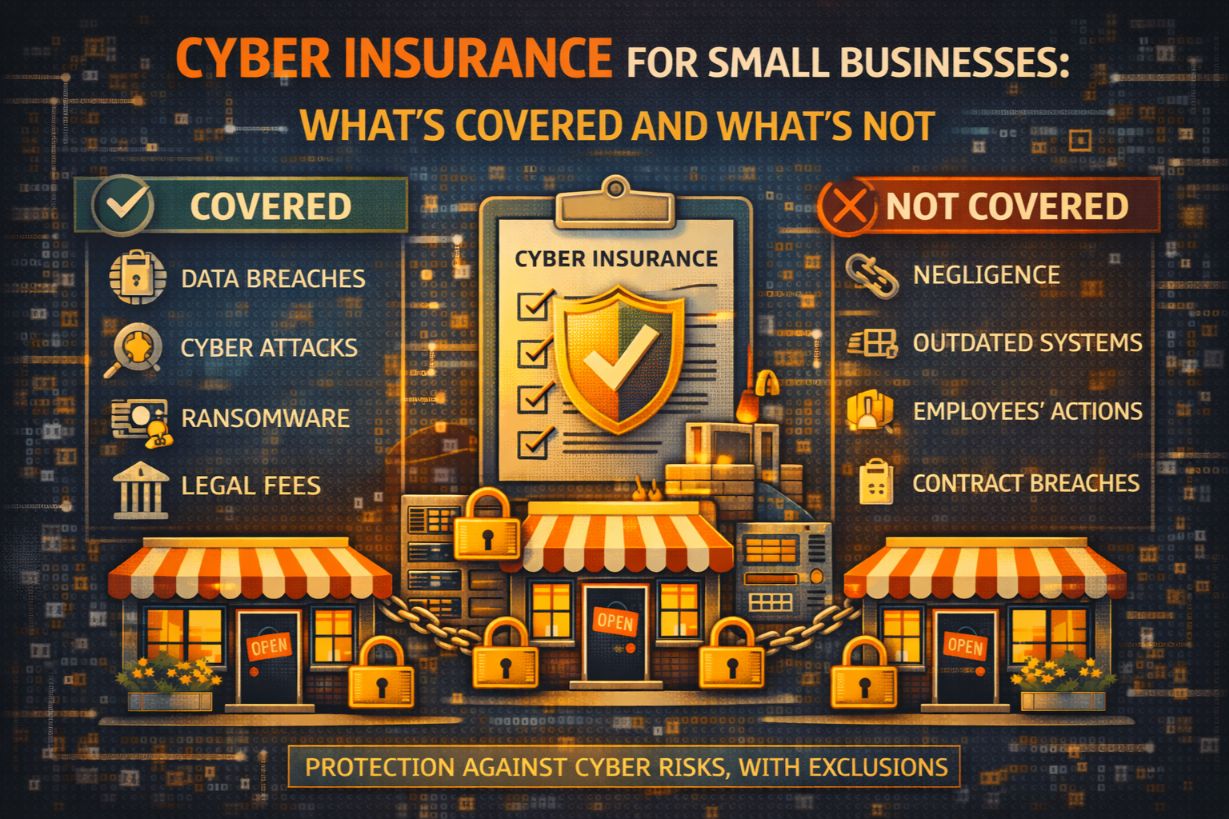
Cyber Insurance for Small Businesses: What’s Covered and What’s Not
Cyber insurance feels like a safety net.
For many small businesses, it’s the last line of defense—the thing they assume will “take care of it” if a cyber incident ever happens. That assumption is understandable.
It’s also dangerous.
Cyber insurance does not replace cybersecurity, does not guarantee reimbursement, and does not cover every type of cyber incident. Many SMBs only discover these gaps after a breach—when denial letters arrive instead of checks.
This article explains cyber insurance for small businesses in practical terms: what it typically covers, what it often excludes, what insurers now require, and how to avoid discovering the limits of your policy the hard way.
Why Cyber Insurance Is Not Optional Anymore (But Not Sufficient)
Cyber insurance exists because cyber incidents are inevitable.
It can help with:
- Incident response costs
- Legal expenses
- Notification requirements
- Business interruption losses
But insurance is risk transfer, not risk elimination.
Insurers expect businesses to:
- Reduce preventable risks
- Implement baseline controls
- Act responsibly
Insurance supports preparation—it doesn’t replace it.
What Cyber Insurance Typically Covers for SMBs
Coverage varies by policy, but most SMB cyber insurance plans include some combination of the following.
1. Incident Response and Forensics
This often includes:
- Incident response specialists
- Digital forensics
- Containment and investigation
This is usually the first and fastest benefit of cyber insurance.
2. Legal and Regulatory Costs
Policies often cover:
- Privacy attorneys
- Regulatory response
- Breach notification drafting
These costs escalate quickly and are difficult for SMBs to absorb alone.
3. Breach Notification and Customer Support
Coverage may include:
- Notification letters
- Call centers
- Credit monitoring services
These are frequently required by law.
4. Ransomware Response (Sometimes)
Some policies cover:
- Ransom negotiation
- Decryption tools
- Ransom payments (within limits)
Coverage depends heavily on:
- Policy language
- Pre-breach controls
- Jurisdiction
5. Business Interruption Losses
Some policies reimburse:
- Lost income during downtime
- Extra expenses to restore operations
These provisions often include:
- Waiting periods
- Coverage caps
- Strict documentation requirements
What Cyber Insurance Often Does NOT Cover
This is where many SMBs are surprised.
1. Claims Denied Due to Missing Controls
Insurers increasingly deny claims when:
- MFA was not enabled
- Systems were unpatched
- Backup practices were inadequate
- Security representations were inaccurate
Applications matter. What you claimed during underwriting becomes enforceable.
2. Social Engineering and BEC (Sometimes Excluded)
Business Email Compromise is often:
- Excluded
- Limited
- Covered only with special endorsements
Many SMBs assume BEC is covered—only to find out it’s not.
3. Pre-Existing Conditions
If vulnerabilities existed before the policy:
- Claims may be denied
- Coverage may be limited
Insurance does not retroactively fix negligence.
4. Reputational Damage
Lost trust, lost customers, and long-term brand harm are rarely covered.
Insurance pays invoices—not reputation repair.
5. Compliance Fines (Sometimes)
Some regulatory fines are:
- Uninsurable by law
- Excluded by policy
Legal costs may be covered—but penalties may not.
Why Cyber Insurance Claims Get Denied
Most denials stem from misalignment between expectations and reality.
Common reasons include:
- Inaccurate application responses
- Lack of documented controls
- Failure to follow policy requirements
- Delayed incident reporting
Insurance companies expect diligence—not perfection.
The Underwriting Shift Hurting SMBs
Cyber insurance underwriting has tightened significantly.
Insurers now ask detailed questions about:
- MFA enforcement
- Backup isolation
- Endpoint security
- Patch management
- Incident response planning
Incorrect answers are grounds for denial.
Why “Yes” Answers on Applications Matter
Underwriting questions are not hypothetical.
If you answer:
“Yes, MFA is enforced on all email accounts”
And it’s not true—coverage is at risk.
SMBs often delegate applications to non-security staff, increasing exposure.
Cyber Insurance and Ransomware: The Reality
Ransomware coverage has changed dramatically.
Insurers now:
- Limit ransom payments
- Require insurer-approved negotiators
- Demand proof of controls
- Exclude repeat incidents
Some insurers won’t pay ransoms at all.
Relying on insurance to “pay the ransom” is no longer viable.
How Cyber Insurance and Cybersecurity Should Work Together
Cyber insurance works best when:
- Controls reduce claim likelihood
- Documentation supports claims
- Monitoring detects incidents early
Security investments often:
- Lower premiums
- Improve coverage terms
- Reduce exclusions
Insurance rewards preparation.
What SMBs Should Do Before Buying or Renewing Cyber Insurance
Before renewal, SMBs should:
- Review application accuracy
- Validate security controls
- Test backups
- Enforce MFA everywhere
- Document incident response plans
Treat underwriting as a security audit—because it effectively is.
Cyber Insurance Is Not a Compliance Shortcut
Having insurance does not mean:
- You’re compliant
- You’re secure
- You’re protected
Regulators and courts do not accept insurance as a substitute for safeguards.
Insurance supports recovery—not responsibility.
Common SMB Cyber Insurance Mistakes
- Buying the cheapest policy
- Not reading exclusions
- Assuming BEC is covered
- Overstating controls
- Ignoring insurer recommendations
These mistakes surface at the worst possible time.
How Much Cyber Insurance Does an SMB Need?
Coverage should reflect:
- Revenue
- Data sensitivity
- Downtime tolerance
- Legal exposure
Too little coverage leaves gaps.
Too much coverage without controls leads to denial.
Balance matters.
The Hard Truth About Cyber Insurance
Cyber insurance helps when:
- You prepared honestly
- You implemented baseline controls
- You respond quickly
It fails when:
- It’s treated as a replacement for security
- Controls are overstated
- Incidents are handled casually
Insurance is a contract—not a promise.
Insurance Is a Backstop, Not a Strategy
Cyber insurance is important.
It is not protection by itself.
For small businesses, the safest position is:
- Strong baseline security
- Honest insurance applications
- Clear understanding of coverage limits
Insurance buys time and resources—but only if you earned it before the incident.
Next Steps
To reduce insurance risk and improve coverage:
- Conduct a cyber risk assessment
- Validate MFA and backup controls
- Review policy exclusions carefully
- Align security controls with underwriting requirements
The worst time to read your cyber policy is after a breach.