
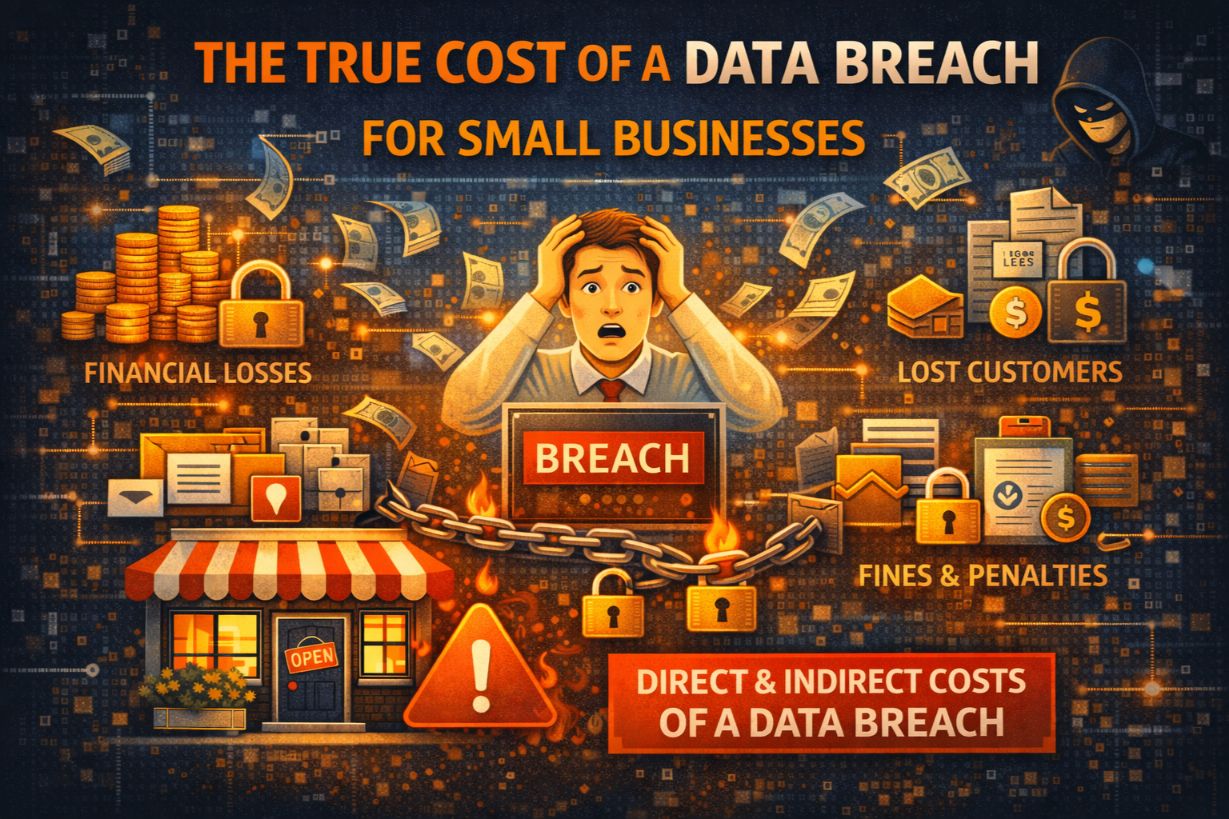
The True Cost of a Data Breach for Small Businesses
Most small business owners underestimate the cost of a data breach.
Not because they’re careless—but because the real costs aren’t obvious until it’s too late. When people think “data breach,” they imagine IT cleanup and maybe a fine.
That’s not where the money goes.
For small businesses, the cost of a data breach spreads across operations, revenue, legal exposure, reputation, insurance, and future growth—often for years after the incident.
This article breaks down the true cost of a data breach for small businesses, where the money actually goes, and why many SMBs never financially recover.
Why SMBs Miscalculate Breach Costs
SMBs often assume:
- “We don’t store that much data”
- “We’ll just fix the systems”
- “Insurance will cover it”
- “It won’t cost more than a few thousand dollars”
Those assumptions collapse quickly.
Breach costs compound because multiple events trigger at once, each with its own price tag.
Cost Category #1: Immediate Incident Response
The moment a breach is confirmed, spending begins.
Common Costs
- Emergency IT services
- Incident response consultants
- Forensic investigations
- System isolation and containment
- Overtime for internal staff
For SMBs, emergency response is expensive because it’s:
- Unplanned
- Time-critical
- Often outsourced at premium rates
Even small incidents can generate five-figure costs within days.
Cost Category #2: Business Downtime and Lost Revenue
Downtime is one of the most underestimated breach costs.
When systems are unavailable:
- Sales stop
- Billing pauses
- Customer service degrades
- Projects stall
For many SMBs, every hour offline directly impacts cash flow.
Downtime costs include:
- Lost sales
- Missed deadlines
- Contract penalties
- Employee idle time
These losses are rarely reimbursed—and they add up fast.
Cost Category #3: Data Recovery and System Rebuilds
Restoring systems isn’t as simple as “turning them back on.”
Recovery often involves:
- Rebuilding servers
- Reconfiguring cloud environments
- Restoring and validating backups
- Replacing compromised devices
If backups fail—or are incomplete—recovery time multiplies.
Long recovery windows mean:
- Extended downtime
- Higher labor costs
- Increased customer dissatisfaction
Cost Category #4: Legal and Regulatory Expenses
Once customer data is involved, legal obligations follow.
Common Legal Costs
- Privacy attorneys
- Regulatory consultations
- Breach notification drafting
- Contractual obligation reviews
If notification laws apply, additional costs include:
- Notification letters
- Call centers
- Credit monitoring services
These costs are mandatory, not optional.
Cost Category #5: Fines, Penalties, and Settlements
Depending on the data involved and jurisdiction, SMBs may face:
- Regulatory fines
- Civil lawsuits
- Contractual penalties
- Settlement agreements
Even if fines are reduced, legal defense costs remain high.
Small businesses rarely have the leverage or resources to negotiate aggressively.
Cost Category #6: Cyber Insurance Gaps and Denials
Cyber insurance helps—but only if conditions were met.
Many SMBs discover post-breach that:
- MFA wasn’t enforced
- Systems weren’t patched
- Controls weren’t documented
- Coverage limits were lower than expected
Denied or partial claims mean:
- Out-of-pocket expenses
- Higher future premiums
- Reduced coverage options
Insurance is a safety net—not a guarantee.
Cost Category #7: Reputation and Customer Trust Loss
Reputation damage is difficult to quantify—but devastating.
After a breach, SMBs often experience:
- Customer churn
- Lost referrals
- Negative online reviews
- Increased sales friction
Unlike large brands, SMBs rely heavily on personal trust and word-of-mouth.
Once trust is damaged, recovery is slow—and sometimes impossible.
Cost Category #8: Increased Operational Costs After the Breach
Post-breach, costs don’t return to normal.
Businesses often face:
- Higher insurance premiums
- Mandatory security upgrades
- Compliance audits
- Ongoing monitoring requirements
Security expectations permanently increase.
What was “acceptable” before the breach no longer is.
Cost Category #9: Leadership Time and Focus
Leadership distraction is an invisible but real cost.
Executives and owners spend weeks or months dealing with:
- Lawyers
- Investigators
- Customers
- Regulators
- Insurance providers
During this time:
- Growth initiatives stall
- Strategy suffers
- Opportunities are missed
The opportunity cost is significant—and unrecoverable.
Cost Category #10: Employee Morale and Turnover
Breaches create internal stress.
Employees may experience:
- Fear
- Burnout
- Blame culture
- Loss of confidence
Some leave.
Replacing skilled staff after a breach adds:
- Hiring costs
- Training costs
- Knowledge loss
Why Small Businesses Feel Breach Costs More Deeply
A $100,000 loss means very different things to different businesses.
For large enterprises, it’s noise.
For SMBs, it can mean:
- Missed payroll
- Delayed vendor payments
- Credit issues
- Business closure
The smaller the business, the less margin there is for error.
The “Hidden” Costs SMBs Rarely Anticipate
Beyond obvious expenses, SMBs face:
- Lost partnerships
- Increased scrutiny from clients
- Contract renegotiations
- Longer sales cycles
Potential customers may quietly choose safer alternatives.
Why Breach Costs Continue Long After Recovery
The financial impact doesn’t end when systems come back online.
Long-term effects include:
- Reduced growth rate
- Higher operating costs
- Persistent reputational damage
- Ongoing compliance obligations
Some SMBs never return to their pre-breach trajectory.
Prevention vs. Recovery: The Cost Comparison
Preventive cybersecurity spending often feels expensive—until compared to breach recovery.
Preventive costs are:
- Predictable
- Budgetable
- Scalable
Breach costs are:
- Sudden
- Uncontrolled
- Often existential
Every dollar spent on prevention reduces the probability of catastrophic loss.
Why “We’ll Deal With It If It Happens” Fails
This mindset assumes:
- The breach will be manageable
- Costs will be contained
- Recovery will be quick
In reality, breaches force decisions under pressure—with limited information and fewer options.
That’s the most expensive way to operate.
What Reduces the Cost of a Data Breach?
SMBs that limit breach costs typically have:
- MFA enforced everywhere
- Tested backups
- Incident response plans
- Logging and monitoring
- Clear vendor responsibilities
These don’t eliminate breaches—but they limit blast radius.
Breach Costs Are Business Costs
The cost of a data breach isn’t an IT line item.
It’s a business-level risk that affects:
- Cash flow
- Trust
- Growth
- Survival
Small businesses don’t need perfect security.
They need enough security that one incident can’t end the company.
Anything less is a gamble.
Next Steps
To reduce potential breach costs:
- Conduct a cybersecurity risk assessment
- Review insurance requirements and exclusions
- Validate backup and recovery processes
- Identify single points of failure
It’s far cheaper to plan for a breach than to finance one.