
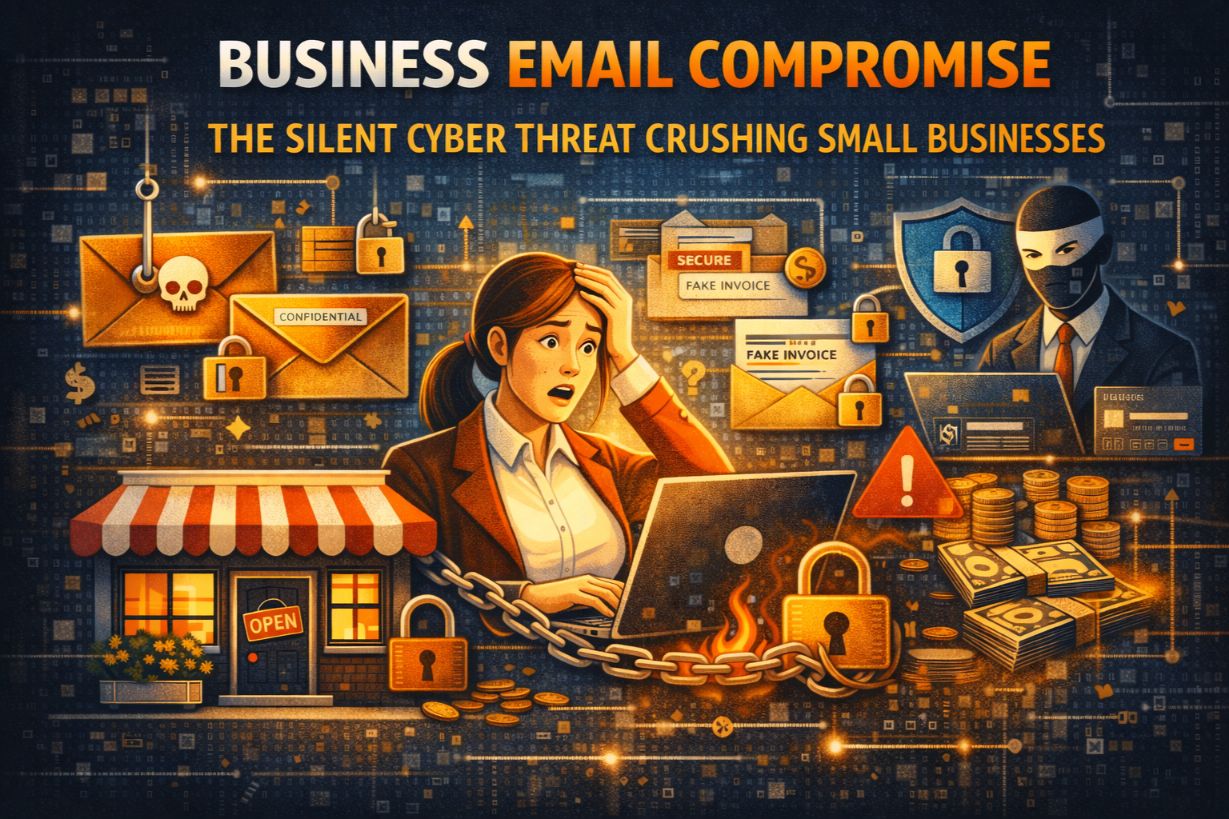
Business Email Compromise: The Silent Cyber Threat Crushing Small Businesses
Business Email Compromise doesn’t encrypt your files.
It doesn’t shut down your systems.
It doesn’t trigger antivirus alerts.
It simply convinces someone in your business to send money to the wrong place.
And by the time you realize what happened, the money is gone.
For small businesses, Business Email Compromise (BEC) is one of the most dangerous cyber threats because it hides in plain sight. No malware. No pop-ups. No obvious red flags. Just a normal-looking email that leads to a very expensive mistake.
This article explains how BEC attacks work, why SMBs are especially vulnerable, how attackers manipulate trust and process, and how to stop email-based fraud before it devastates your business.
What Is Business Email Compromise (BEC)?
Business Email Compromise is a form of cybercrime where attackers impersonate a trusted person or organization to trick employees into:
- Sending wire transfers
- Changing payment details
- Purchasing gift cards
- Sharing sensitive financial information
Unlike phishing, BEC attacks often involve:
- Real email accounts
- Ongoing conversations
- No malicious links or attachments
This makes BEC incredibly difficult to detect with traditional security tools.
Why BEC Is So Effective Against Small Businesses
BEC attacks work because they exploit process and trust, not technology.
Small businesses are vulnerable because:
- Financial duties are concentrated among few people
- Approval workflows are informal
- Employees wear multiple hats
- Requests from leadership are rarely questioned
Attackers know that in SMBs, speed often matters more than verification.
The Different Types of BEC Attacks Targeting SMBs
1. CEO Fraud
Attackers impersonate:
- The owner
- The CEO
- A senior executive
They send urgent messages like:
“I need you to handle a wire transfer ASAP. I’m in meetings—don’t call.”
Employees comply because the request appears legitimate and authoritative.
2. Vendor Payment Diversion
This is one of the most common BEC scams.
Attackers:
- Compromise or spoof a vendor’s email
- Monitor invoices and payment cycles
- Send updated banking details
The business pays the invoice—just to the wrong account.
This type of fraud often goes unnoticed for weeks.
3. Account Compromise-Based BEC
Attackers:
- Steal credentials via phishing
- Log in to real email accounts
- Monitor conversations silently
When the timing is perfect, they send fraudulent payment instructions from a legitimate internal account.
This bypasses many security controls entirely.
4. Payroll Diversion
Employees receive emails instructing them to:
- Update direct deposit information
- Change payroll details
Funds are redirected to attacker-controlled accounts.
5. Gift Card Scams
While smaller in scale, these are common and persistent.
Employees are instructed to:
- Buy gift cards
- Scratch off codes
- Email the numbers
These funds are unrecoverable.
Why BEC Attacks Often Succeed Undetected
BEC attacks don’t look like cybercrime.
They look like:
- Routine business communication
- Familiar workflows
- Legitimate requests
Because there is:
- No malware
- No suspicious links
- No attachments
Security tools often see nothing wrong.
The only defense is process and verification.
The Financial Impact of BEC on Small Businesses
BEC attacks cost SMBs:
- Immediate financial losses
- Legal fees
- Recovery costs
- Insurance disputes
- Reputational damage
Many SMBs cannot absorb six-figure losses.
Unlike ransomware, BEC losses are often not recoverable, even with insurance.
Why Cyber Insurance Often Fails with BEC
Many SMBs assume cyber insurance will cover email fraud.
In reality:
- Some policies exclude social engineering
- Others require strict controls
- Many require proof of verification procedures
If controls aren’t documented and followed, claims may be denied.
BEC exposes the gap between assumed coverage and actual protection.
How Attackers Prepare BEC Attacks
BEC is not random.
Attackers:
- Study your business online
- Identify finance staff
- Learn vendor relationships
- Observe email tone and timing
This reconnaissance allows them to blend in seamlessly.
BEC succeeds because it looks normal.
Why Small Businesses Rarely Report BEC Incidents
Many SMBs don’t report BEC attacks because:
- The loss is embarrassing
- The mistake feels internal
- Recovery seems unlikely
This underreporting allows attackers to continue targeting similar businesses.
How Small Businesses Can Stop BEC Attacks
BEC cannot be stopped by antivirus alone.
It requires layered controls and disciplined processes.
1. Enforce MFA on All Email Accounts
MFA prevents attackers from accessing real email accounts—even if credentials are stolen.
This single control blocks a massive percentage of BEC attacks.
2. Implement Financial Verification Procedures
Any request involving:
- Payment changes
- Wire transfers
- Banking updates
Should require out-of-band verification (phone call, separate approval).
Urgency is the attacker’s weapon. Verification disarms it.
3. Secure Email Domains Properly
Implement:
- SPF
- DKIM
- DMARC
These controls reduce spoofing and impersonation.
4. Use Impersonation Protection
Advanced email security tools can detect:
- Lookalike domains
- Executive impersonation
- Vendor spoofing
Default email filtering is not enough.
5. Train Employees on BEC Scenarios
Training should include:
- Realistic BEC examples
- Verification expectations
- Clear escalation paths
Employees should be empowered to slow down suspicious requests.
6. Limit Who Can Approve Payments
The fewer people with financial authority, the smaller the attack surface.
Segregation of duties reduces risk significantly.
Why BEC Is a Leadership Problem
BEC succeeds when:
- Processes are informal
- Verification is discouraged
- Speed is prioritized over accuracy
Leadership sets the tone.
If executives bypass controls or pressure employees to “just get it done,” attackers exploit that culture.
The Most Dangerous Attacks Look Legitimate
Business Email Compromise doesn’t feel like a cyberattack.
That’s why it works.
For small businesses, BEC represents a perfect storm:
- High trust
- Limited controls
- Significant financial impact
The businesses that stop BEC don’t rely on hope or tools alone.
They rely on discipline, verification, and awareness.
Next Steps
To reduce BEC risk in your business:
- Enforce MFA on email immediately
- Review financial approval workflows
- Implement email authentication
- Train staff on real-world BEC scenarios
One fake email should never be able to drain your business account.